
Our bathroom painting project came out beautifully. Clean edges and a flawless finish!
Industrial and Protective Coatings in Long Beach, CA
Long Beach Expert Painting is Los Angeles County's trusted expert in industrial and protective coatings, the contractor plant managers, logistics operators and facility managers call for protective work, covering high-build epoxy and polyaspartic floor systems, structural steel and tank coating, parking garage and traffic deck membranes, and intumescent fireproofing.
We take projects from a 5,000 square foot floor section to warehouse and industrial packages past 200,000 square feet. Our crews work active distribution buildings, occupied garages and operating plants, sequencing against shutdown windows, night shifts and weekend outages so racking stays loaded and the dock keeps running. Fully licensed, insured and bonded, with COI, W-9 and references available on request.
From a moisture vapour test and a written surface preparation standard before a single pail is opened, through containment, confined space entry and coating inspection, to a closeout package with batch numbers, mix ratios and cure records logged by area, our team handles the parts of a coatings project that decide whether the system performs.
Serving Long Beach and the surrounding Los Angeles County market, we work inside your outage window, hold the schedule the operation was planned around, and hand the area back ready for inspection and return to service.
Request a FREE Quote!
Or call (562) 269-1108. Calls only, we do not receive text messages.
Thank you. Your request is in. We reply the same business day, and you can always call (562) 269-1108.
- Moisture tested before the system is confirmed
- Prep standard stated in writing
- Cure and return-to-service documented
- Licensed, insured and bonded
Reviews
What Customers Say About Our Industrial & Protective Coatings Work
We needed our office repainted without creating a major disruption for employees. Long Beach Expert Painting handled the project efficiently and gave the entire workspace a brighter, more professional appearance.
The painters took great care around our furniture, flooring, and fixtures. Our walls and ceilings look fantastic, and there were no drips or messy edges left behind.
Our new accent wall looks perfect. It completely changed the feel of the room.
Long Beach Expert Painting helped us choose colors that complemented our flooring and natural lighting. The finished interior feels warm, coordinated, and much more inviting. We are extremely happy with the transformation.
Beautiful exterior painting and excellent workmanship from beginning to end.
We hired the team to paint several units in our rental property. The walls, doors, and trim were finished neatly, and each space looked fresh and ready for new tenants. The results made a noticeable difference.
Our commercial storefront needed an update, and Long Beach Expert Painting delivered exactly what we wanted. The new color scheme looks clean and professional, giving the building a much stronger street presence.
01
Scope and project size
Plant and facility managers with an operating schedule that decides the entire job. Logistics operators running warehouses where a floor has to cure hard enough for forklift traffic by a fixed return-to-service hour. Property managers with parking structures where the deck membrane is past service life. General contractors carrying a coatings or fireproofing line who need documented thickness, adhesion and cure records at closeout.
| Coating scope | Typical measures |
|---|---|
| Protective coatings, structural steel and tanks | Surface prep to a specified standard, primer plus intermediate plus topcoat |
| Warehouse and industrial package | 40,000 to 200,000 sq ft of wall, deck, structure and equipment |
| Commercial epoxy and polyaspartic floor | 10,000 to 80,000 sq ft of slab, shot blast or diamond grind, moisture testing |
| Parking garage and traffic deck system | 50,000 to 250,000 sq ft of deck, joint and crack treatment, ramps and turn lanes |
| Fireproofing and intumescent coating | Structural steel to a rated assembly, thickness verified and documented |
| Striping and pavement marking | Stalls, fire lanes, crosswalks, dock and aisle markings |
Property types include tilt-up distribution and warehouse buildings, manufacturing and process facilities, cold storage and food handling space, maintenance and equipment shops, subterranean and structured parking, and port-adjacent steel structures, tanks and racking.
02
Surface preparation sets the outcome
A protective coating rarely fails because of the paint. It fails because of what was under it.
Profiling the substrate
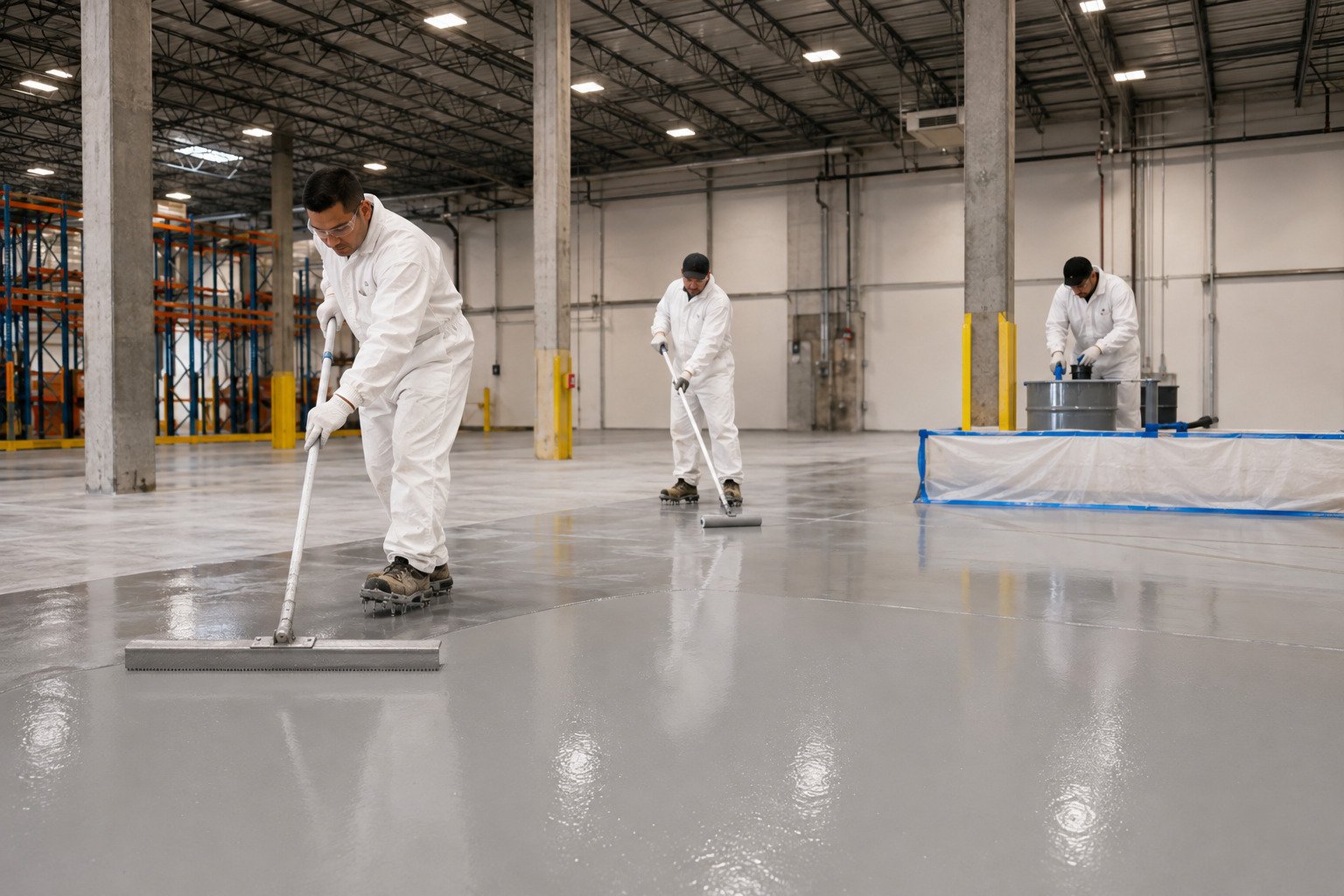
Shot blasting is the default on large industrial slabs. It profiles the concrete uniformly, removes laitance and old coating, and produces the roughened surface a high-build system needs to key into.
Diamond grinding goes where shot blast cannot: edges, columns, tight bays, occupied floor sections needing low dust, and slabs where a thinner system is specified.
Steel preparation runs abrasive blast or power tool cleaning to a specified standard, written into the bid so there is no later argument about what "prepared" meant.
Testing and repair
Moisture vapour testing happens before the system is confirmed, not after. A slab passing vapour upward lifts an epoxy floor off in sheets, and that failure is exactly the blistering and peeling the trade attributes to moisture present in the substrate. Where readings are high, a mitigation primer goes into the scope and the number changes before the contract, not after.
Crack, joint and spall repair is scope, not an add. An untreated joint telegraphs through a floor system within a season.
03
Epoxy, and why it gets a topcoat
Epoxy is two components mixed in a precise ratio that react to form a third chemical. That reaction is exothermic and in some cases produces enough heat to cause thermal degradation if it is not controlled, which is why mix size, pot life and ambient temperature are managed on site rather than eyeballed.
Three bonds, one of them yours to earn
It bonds mechanically into a roughened surface, by proximity, and ionically. That is why the profile from shot blasting or diamond grinding matters more than the label on the pail.
The UV limitation
Epoxy paints tend to deteriorate under UV exposure, a failure the trade calls chalking out, and they yellow over time by oxidation. So epoxy is the body of the system, not the face of it. Where a floor or a steel surface sees daylight we specify a UV-stable polyaspartic or urethane topcoat over it, which also gives a faster return to service.
| System | Where it goes | What it gives you |
|---|---|---|
| High-build epoxy, broadcast aggregate, urethane topcoat | Warehouse floors, shops, back of house | Impact and abrasion resistance, slip profile, chemical tolerance |
| Epoxy primer plus polyaspartic topcoat | Fast-turn floors, daylight-exposed bays | Rapid cure and return to service, UV stability the epoxy alone does not have |
| Moisture mitigation primer under an epoxy system | Slabs with elevated vapour readings | Keeps the system from lifting off a slab that is still passing moisture |
| Epoxy or zinc-rich primer, epoxy intermediate, urethane finish on steel | Structural steel, racking, tanks, handrail | Corrosion protection with a UV-stable face coat |
| Traffic deck urethane membrane | Parking decks, ramps, turn areas | Waterproofing plus wear course under vehicle traffic |
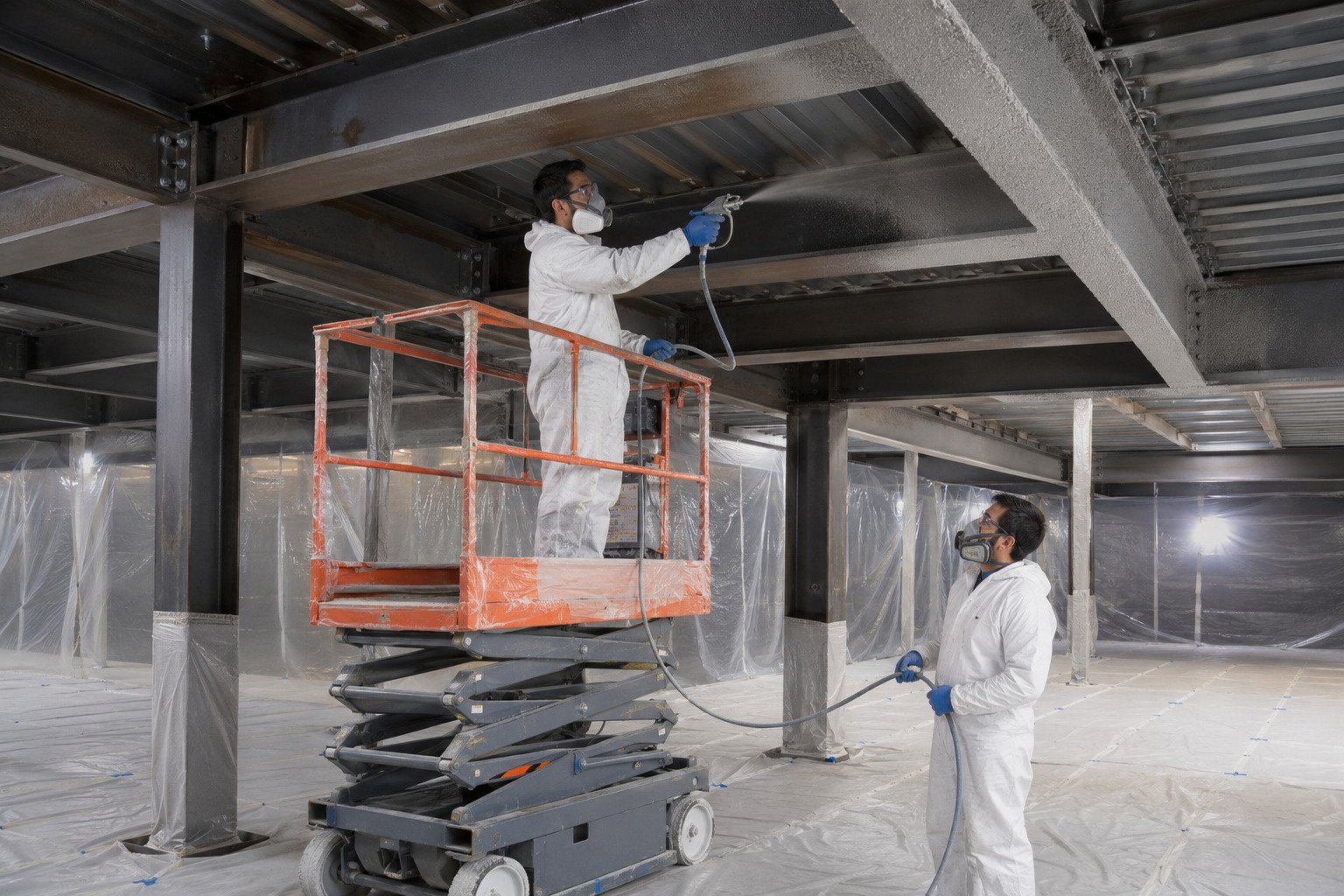
| Intumescent coating | Rated structural steel | Fire rating with thickness verified and documented |
| Traffic paint and thermoplastic marking | Stalls, fire lanes, aisles, dock zones | Visible, code-compliant marking that survives traffic |
04
Working in operating facilities
A coatings project inside a running building is a logistics exercise with resin attached.
Windows, containment and confined space
Shutdown and outage windows. We plan backwards from the return-to-service hour and say at bid time whether the window is realistic for the system specified. A polyaspartic topcoat exists partly to make short windows possible.
Containment. Blasting and grinding run under containment with HEPA-filtered vacuum collection so adjacent production, racked product and staff are separated from the work, plus overspray containment on steel and structure coating.
Confined space. Tank interiors, pits, vaults and enclosed structures run under a confined space entry program with atmospheric monitoring, attendant, ventilation and a rescue plan. It is a documented procedure or it does not happen.
Phasing, hours and ventilation
Phasing. Floors run in bays and aisles so racking stays loaded and forklift routes stay open. Garages run level by level with published closure dates and rerouted traffic, so parking count never drops below what the property can absorb.
Night and weekend work. Standard on occupied garages, active docks and operating plants, and priced in the bid rather than added as a change.
Odour and ventilation. Low-VOC products meeting Green Seal GS-11 where the system allows, mechanical ventilation and exhaust where it does not, and written notice to your safety officer on any product requiring it.
Safety and compliance
Site-specific safety plans, contractor orientation, lockout and tagout coordination with your maintenance group, hot work permits where required, fall protection on elevated steel, and a confined space program on tank and vault work. On older industrial steel, coating removal can encounter lead-bearing or otherwise regulated existing coatings, so we call for testing before removal rather than discovering it mid-blast.
05
Scheduling and local industrial proof
Cure and return to service are scheduled, not guessed.
Lead time and duration
Award to mobilisation typically runs two to six weeks, driven by material lead time, moisture testing results and your outage calendar. Field duration runs roughly three to seven days on a 10,000 square foot epoxy floor including prep and cure, two to six weeks on a full warehouse package, and four to twelve weeks on a multi-level parking deck phased by level.
Epoxy cure is temperature dependent and the exothermic reaction has to be managed, so ambient conditions, slab temperature and mix size all go into the schedule. Where the marine layer keeps a slab damp into mid-morning, work starts later, and that is on the calendar at bid time.
The port sets the standard
The Port of Long Beach is the second busiest container port in the United States, and the infrastructure around it sets coatings demand in this city. Steel structures, racking, tanks and equipment near the water carry a salt load that ordinary architectural paint does not answer. Salt off San Pedro Bay settles on a surface, holds moisture against it, and drives corrosion under any film not specified for the exposure.
The Intermodal Container Transfer Facility on the western edge of West Long Beach, and the industrial stock along Santa Fe Avenue and the I-710 corridor, run tilt-up warehouse and transfer buildings where slab coatings, dock zones, aisle striping and structural steel are the recurring scopes. The Terminal Island Freeway carries the traffic between them, and the refinery belt nearby marks the heavy process environment that sets the standard for containment, confined space work and outage-window discipline here.
Site walk
We walk the slab, the structure and the equipment with your maintenance lead, check coating adhesion, and look for delamination, spalling, joint failure and corrosion.
Testing and takeoff
Moisture vapour readings on slabs, thickness and adhesion checks on steel, square footage by area and substrate, linear footage of joints and striping, and the access and containment method per area.
Written bid
System specification by area, surface preparation standard stated in writing, coats and film build, containment and confined space provisions, outage window assumptions, exclusions and unit rates.
Submittals and samples
Product and safety data sheets, VOC documentation, mix ratio and cure data, and a sample area for colour, texture and slip profile approval.
Scheduling and phasing
Area sequence, shutdown windows, return-to-service hours, night and weekend shifts, and the traffic or racking plan for each phase.
Execution
Shot blast or diamond grind, joint and spall repair, moisture mitigation where readings require it, prime, build coats, topcoat, then striping last.
Punch and inspection
Walked by area with your facility lead or the GC's superintendent, with thickness and cure readings recorded before release.
Closeout
Batch numbers, mix ratios, prep records, dry film thickness readings, cure and return-to-service records, warranty letters and final lien releases.
06
Frequently asked questions about industrial coatings
How small or large a industrial coatings job will you take?
From a single-bay floor or a striping-only scope up to warehouse and industrial packages past 200,000 square feet and multi-level parking decks phased by level.
Do you bid from plans and specifications?
Yes. Send the coating schedule, the specification section, a structural drawing set or a fireproofing rating requirement and we bid to it, listing clarifications and exclusions. Where the spec and the existing substrate conflict, we say so in writing before award.
Do you test the slab before quoting a floor?
Yes. A slab still passing vapour will lift an epoxy floor, so a mitigation primer belongs in the contract rather than in a change order. We will not warrant a floor installed over untested slab.
Can we be named additional insured on a coatings package?
Yes, with primary and non-contributory wording and waiver of subrogation available on your form, workers compensation certificates, and a COI before mobilisation.
Are you bondable, and do you do prevailing wage or public work?
Yes. Payment and performance bonds are available on qualifying contracts, and we can run certified payroll on prevailing wage and public bid packages.
Can you work inside a shutdown or outage window?
Yes, planning backwards from the return-to-service hour. If the window is too short for the system specified we say so at bid time and propose a faster-curing system such as a polyaspartic topcoat, rather than promising a cure that will not happen.
Do you do confined space and containment work?
Tank interiors, pits and vaults run under a confined space entry program with atmospheric monitoring, an attendant, ventilation and a rescue plan. Blasting and grinding run under containment with HEPA collection.
How do you phase a garage or an occupied warehouse?
Level by level and bay by bay, with published closure dates, rerouted traffic and maintained forklift routes, so parking count and racking access stay within what the operation can absorb.
Can you handle striping and fire lane marking in the same package?
Yes, and striping goes last by design so it is not damaged by the coating work ahead of it. Stalls, aisles, dock zones, crosswalks and fire lanes are all in scope.
What documentation do we get at closeout?
Batch numbers, mix ratios, prep records, dry film thickness readings, cure and return-to-service records, warranty letters and final unconditional lien releases.
07
Related commercial services
Coatings packages usually sit alongside other scopes.
- Commercial Building Exterior Painting
- Office & Retail Interior Painting
- Apartment Complex Painting
- HOA & Condo Association Painting
- Apartment Turnover Painting
- Commercial Painting Contractors
Painting service areas
Coatings crews work Long Beach, the port and the industrial corridor through Carson, Paramount and the Gateway Cities.
Request a coatings bid
Send the area, the substrate and your outage calendar. We will take moisture readings, confirm a system specification, and return a written bid with the surface preparation standard stated in full.
- Prep standard written into the bid
- Return-to-service planned backwards
- Licensed, insured and bonded
Request a FREE Quote!
Or call (562) 269-1108. Calls only, we do not receive text messages.
Thank you. Your request is in. We reply the same business day, and you can always call (562) 269-1108.