
We had peeling paint and minor surface damage on the outside of our home. The team prepared the problem areas carefully before applying the new paint. The finished exterior looks smooth, durable, and professionally restored.
Stucco Painting in Long Beach, CA That Works With the Wall, Not Against It
Long Beach Expert Painting is Los Angeles County's trusted expert in stucco coatings, specializing in hairline and stress crack repair, elastomeric coating systems, and breathable mineral silicate finishes for older lime walls. We offer full-property stucco repaints and matched patch texturing.
Our team provides the complete stucco prep sequence, pressure washing, crack cutting and filling, masonry priming and back-rolling, delivering coatings matched to the wall's permeability for homes and long-cycle systems for both residential and commercial projects. Fully licensed, insured and bonded, we have coated everything from a single cracked garage elevation to a full two-story stucco envelope.
From identifying whether a wall is Portland cement or traditional lime before we choose a product to a complete high-build system with every crack cut, filled and textured to match, our team handles every detail. Serving Long Beach, Lakewood, Paramount and Bellflower, we ensure fast, efficient service and deliver reliable, professional, and beautiful results on every stucco painting project.
Request a FREE Quote!
Or call (562) 269-1108. Calls only, we do not receive text messages.
Thank you. Your request is in. We reply the same business day, and you can always call (562) 269-1108.
- Substrate identified before product
- Cracks cut, filled and textured
- Sprayed and back-rolled, never sprayed only
- Licensed, insured and bonded
Reviews
What Customers Say About Our Stucco Painting Work
We needed our office repainted without creating a major disruption for employees. Long Beach Expert Painting handled the project efficiently and gave the entire workspace a brighter, more professional appearance.
The painters took great care around our furniture, flooring, and fixtures. Our walls and ceilings look fantastic, and there were no drips or messy edges left behind.
Our new accent wall looks perfect. It completely changed the feel of the room.
Long Beach Expert Painting helped us choose colors that complemented our flooring and natural lighting. The finished interior feels warm, coordinated, and much more inviting. We are extremely happy with the transformation.
Beautiful exterior painting and excellent workmanship from beginning to end.
We hired the team to paint several units in our rental property. The walls, doors, and trim were finished neatly, and each space looked fresh and ready for new tenants. The results made a noticeable difference.
Our commercial storefront needed an update, and Long Beach Expert Painting delivered exactly what we wanted. The new color scheme looks clean and professional, giving the building a much stronger street presence.
01
What stucco actually is, and why it matters to the coating
Stucco is aggregates plus a binder plus water. The base recipe is lime, water and sand, and modern mixes add fibres and synthetic acrylics for strength and flexibility. That sounds like one material. It is at least two, and they behave in opposite ways.
Traditional lime stucco
Highly permeable, almost as good as clay at balancing humidity, and slightly self-healing, because lime is faintly water soluble, so deposits redissolve and resolidify inside hairline cracks. A wall like that is designed to breathe. Much of the 1920s stock in the historic districts works on that principle whether the owner knows it or not.
Portland cement stucco
The opposite. Very hard and brittle, it cracks and separates from the surface easily if the base it was applied to is not stable. Cracks in a cement wall usually trace back to movement, not to the coating on top.
What sits underneath
A three-coat system is a scratch coat, a brown coat and a finish coat over lath. A one-coat synthetic system is a single base layer plus a thinner finish layer. Lath comes in expanded-metal, woven-wire and welded-wire forms, and over wood framing the wall needs asphalt-saturated paper or a building wrap that lets vapour escape.
Bad curing explains a lot of bad walls
If stucco dries too soon during application, the chemical hardening is incomplete and the result is weaker, more brittle stucco. Walls cured badly forty years ago crack more, hold coatings worse, and need more patch work before paint. We can usually tell at the walkthrough.
02
The permeability trap
Here is the mistake that costs Long Beach homeowners the most money. An owner with an old lime stucco house sees hairline cracking and buys the heaviest, most-advertised elastomeric available. It is a legitimate product and it does bridge cracks. It is also a dense, low-permeability film. Put it on a wall engineered to breathe and you seal the moisture in.
| Coating | Permeability | Crack bridging | Best fit |
|---|---|---|---|
| Standard acrylic latex | Moderate, breathes reasonably | Minimal, cosmetic only | Sound cement stucco with little or no cracking, repaints on a good film |
| High-build acrylic | Lower than standard | Fills fine hairlines | Cement stucco with light hairline mapping |
| Elastomeric | Low, forms a heavy sealing film | Strong, bridges moving hairline cracks | Portland cement stucco with active hairline cracking. Never on breathable lime walls |
| Mineral silicate paint | Very high, stays breathable | None, cracks are repaired first | Traditional lime stucco, historic masonry, any wall that must release vapour |
| Limewash | Very high, absorbed into the substrate | None | Historic lime walls where an authentic finish is wanted. Limited against rain-driven water ingress |
A few years after the wrong choice, the film comes off in sheets, which is exactly the blistering and peeling the trade attributes to improper surface treatment and moisture already present in the substrate. Mineral silicate systems are the answer on old permeable walls. They keep the breathability limewash gives while lasting considerably longer, and they do not trap the vapour that pushes a modern film off a wall.
03
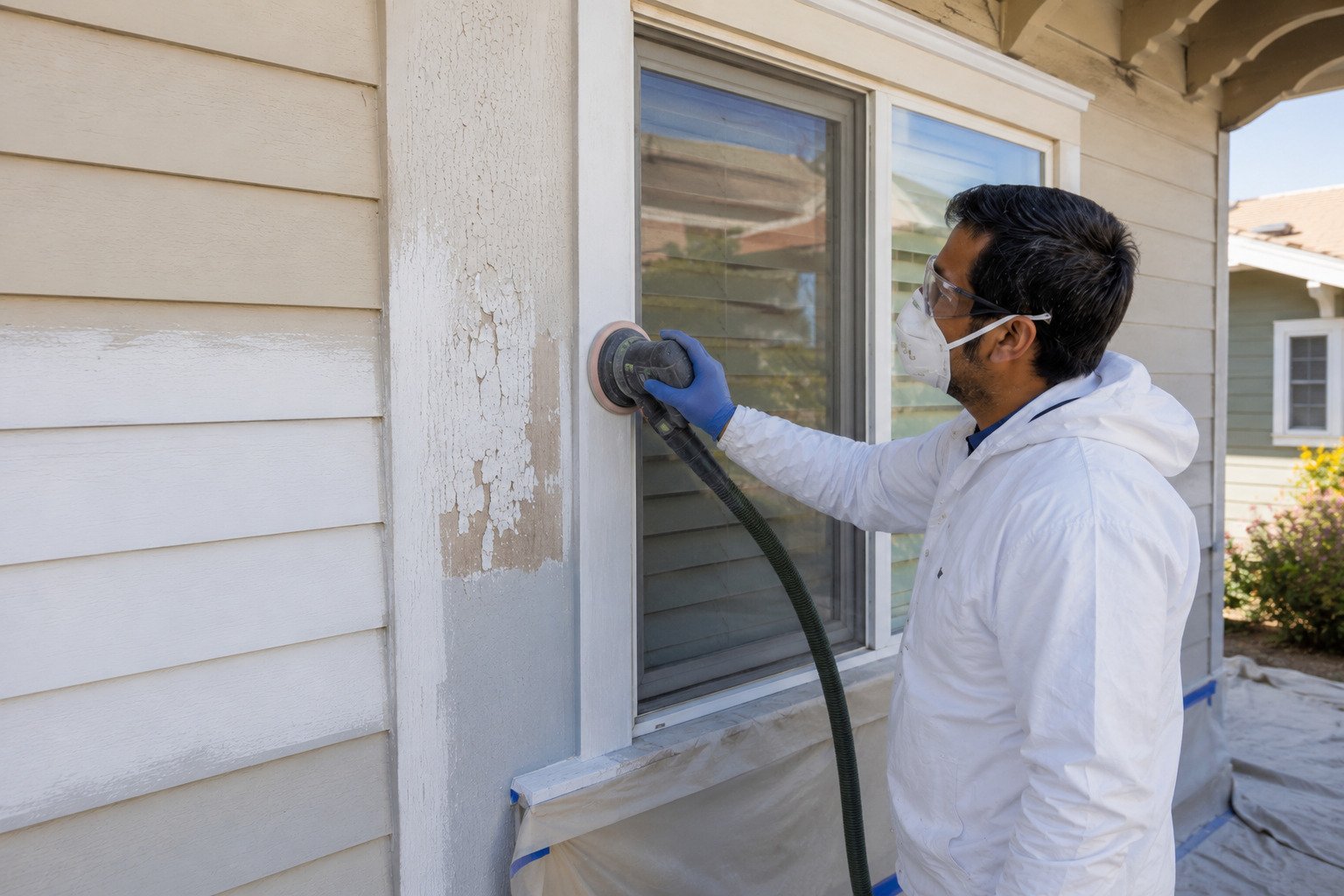
Crack repair comes first
No coating fixes a crack. It only decides how long the crack stays invisible.
Four things we find, and what each needs
- Hairline cracks under about a sixteenth of an inch get cleaned out, filled with a flexible patching compound, and textured to match.
- Stress cracks off window and door corners are movement cracks. Cut open to a V, cleaned, filled, reinforced with mesh where needed, textured, then given a bridging system over the top on a cement wall.
- Delamination, where the stucco has separated from the base and sounds hollow, is not a paint problem. It gets removed and rebuilt first.
- Texture matching separates a real stucco job from a patched one. Sand finish, dash, lace, cat face and smooth trowelled each take a different hand and tool.
We match the surrounding texture on every patch and check it in raking sunlight before priming, because a patch that reads flat at noon reads like a scar at four.
Application on textured walls
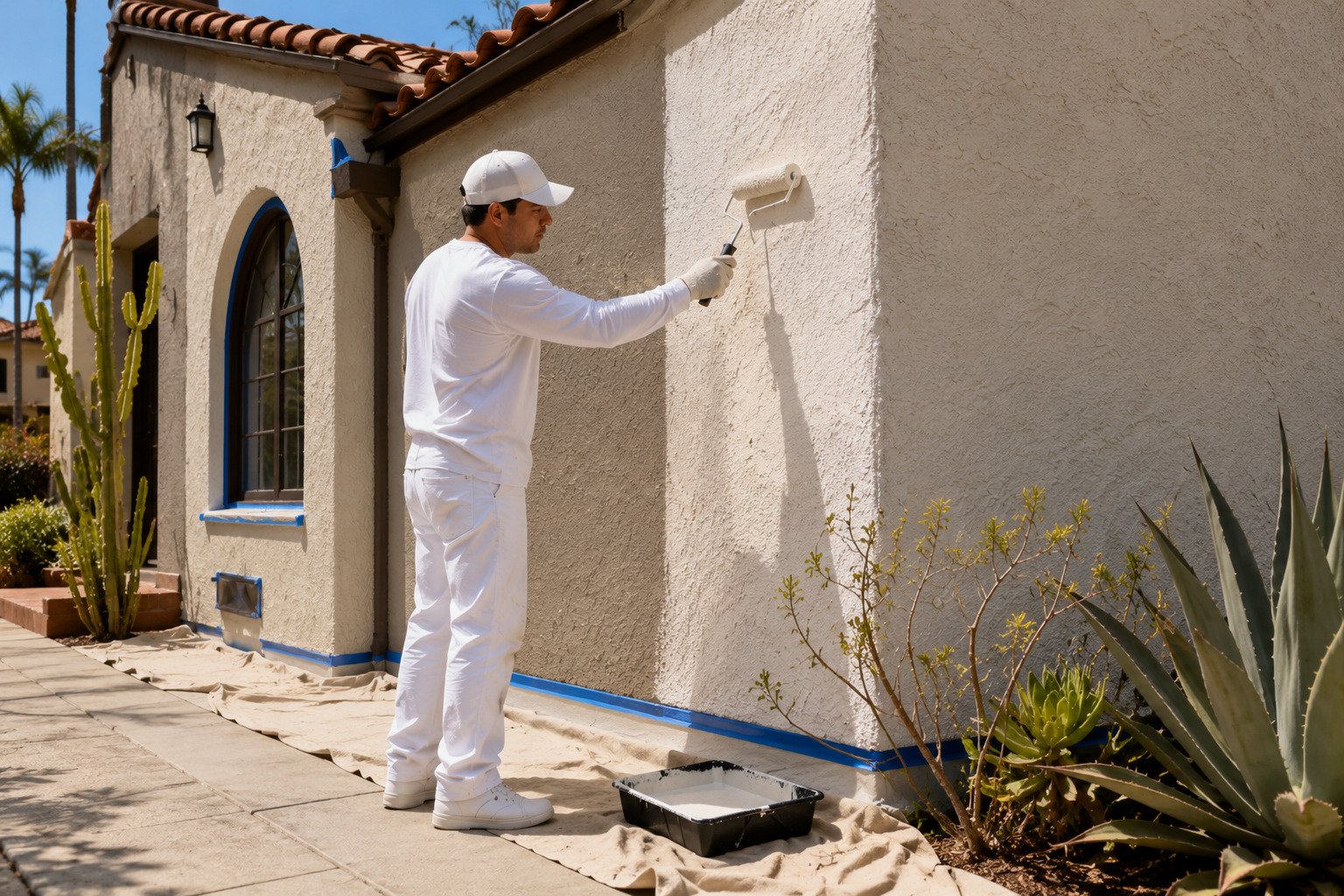
Stucco is not a flat surface and does not take paint like one. Rollers get a thicker nap so the film reaches into the valleys instead of skimming the peaks, thicker still on heavy dash or lace.
Where we spray, we back-roll behind the gun, which pushes the film into the texture and seats it against the substrate rather than bridging across the top. A sprayed-only stucco wall can look perfect and still fail early, because the coating never contacted a third of the surface.
Elastomeric in particular is applied to a specified film thickness, not to visual coverage. Two coats at the right build, not three thin ones adding up to the wrong number.
04
Long Beach stucco conditions
Stucco is the dominant exterior in this market, and the local climate works on it three ways.
UV, salt and morning damp
Long Beach takes only 12.02 inches of rain a year at a 64.9 degree average, which means long UV exposure. That drives chalking, the progressive powdering of the film assessed under ISO 4628 Part 6, and it hits south and west elevations first every time. A ten-year-old repaint in the Wrigley Area looks sound on the north side and powders visibly on the west.
Salt off San Pedro Bay settles on the wall and holds moisture against the film, accelerating that same erosion. And the marine layer means the wall is often damp in the morning even when it has not rained, so coating a wall that only looks dry at nine a.m. is how you get blistering later. We work the sun side first and follow the drying around the house.
Two markets, two specifications
The 1920s and 1930s stock in California Heights and the Wrigley Area is where permeability matters most. California Heights alone holds about 1,500 homes developed between 1925 and 1927 and built out by 1939, and exterior modification there requires a Certificate of Appropriateness.
The uniform 1950s tracts in Lakewood are the other side of the market: mostly cement stucco, mostly hitting repaint age together, and generally a straightforward acrylic or elastomeric specification.
What shapes your estimate
- Crack quantity and type. Ten hairlines is prep. Two hundred feet of mapped cracking with stress cracks at every opening is a repair job with a coating at the end.
- Coating system. A standard acrylic repaint and a full elastomeric build at specified thickness are different material budgets entirely.
- Texture. Heavy lace and dash take substantially more material per square foot than a smooth trowelled wall of the same size.
- Height, access and repair. Two stories on a tight lot means staging. Delaminated sections, damaged corners and previous bad patches get rebuilt before coating.
05
Why homeowners choose us for stucco
We identify the wall before we pick the product
Lime or cement changes everything downstream. Guessing is how a house ends up with a sealed wall and a peeling coating.
We repair cracks, then texture them
Cut, clean, fill, reinforce where needed, texture to match, check in raking light. Then coat.
We back-roll
Spray alone bridges texture, back-rolling seats the film. It costs labour and it is not optional here.
We build elastomeric to spec
Film thickness is the entire performance claim of the product, so we apply the specified build rather than whatever looks covered.
06
Frequently asked questions about stucco painting
Do you offer free written estimates on stucco painting?
Yes. We walk the elevations, measure, count and classify the cracking, identify the substrate, and give you an itemised written estimate at no charge. Call (562) 269-1108.
Should I repair the stucco or recoat it?
Both, in that order. Hairline and stress cracks get repaired and textured first, delaminated areas get rebuilt, and the coating goes over a sound wall. A coating applied over unrepaired cracking will telegraph within a season.
How soon can you start and how long does it take?
Most stucco projects start within one to three weeks. A single story typically runs four to seven working days including wash, dry-out and crack repair, and a crack-heavy two story eight to fifteen.
Do you cover my ZIP code for stucco painting?
We cover Long Beach ZIP codes 90802 through 90815 and 90810 in West Long Beach, plus Lakewood, Paramount, Bellflower, Signal Hill and our other service cities. Call with the address if you are unsure.
Is elastomeric always the right choice?
No, and that is the most important answer on this page. Elastomeric bridges cracks well on Portland cement stucco. On a traditional lime wall it traps vapour and comes off in sheets. Those walls get a breathable mineral silicate system instead.
How long does a stucco coating last here?
It depends on exposure and system. South and west elevations chalk first, and homes near the water carry salt load on top of UV, so a coastal elevation runs a shorter cycle than the same wall inland in Lakewood or Cerritos.
What preparation is included in a stucco painting estimate?
Pressure washing, crack cutting and filling, texture matching, masonry priming, and masking of windows, hardscape and landscaping. Delamination repair and large patch rebuilds are separate line items.
How do I know whether my wall is lime or cement?
Age is the first clue and a close look at the finish coat is the second. On a pre-1940 house we test rather than assume, because getting this wrong is the single most expensive error available on a stucco wall.
Can a hollow-sounding area just be painted over?
No. Hollow means the stucco has let go of the base behind it. Coating it holds the failure in place for a season and then the whole section comes away, usually taking the new paint with it.
Is your crew licensed and insured for stucco painting?
Yes. We are fully licensed, insured and bonded, with a certificate of insurance provided on request.
07
Related painting services
Stucco rarely gets coated on its own. These are the scopes that travel with it.
- Exterior House Painting
- Limewash & Mineral Coatings
- Brick & Masonry Painting
- Historic Home Restoration Painting
- Marine & Coastal Exterior Repaint
- All painting services in Long Beach, CA
Painting service areas
Stucco is the dominant exterior across all ten cities we cover.
Get your free stucco painting estimate
Send us the address. We will identify the substrate, classify the cracking, measure the elevations, and give you an itemised written estimate naming the repair scope and the coating system.
- Free written estimate
- Substrate identified, not assumed
- Licensed, insured and bonded
Request a FREE Quote!
Or call (562) 269-1108. Calls only, we do not receive text messages.
Thank you. Your request is in. We reply the same business day, and you can always call (562) 269-1108.