
The team painted our kitchen cabinets, and we couldn’t believe the difference. The doors and drawers have a smooth, factory-like finish, and the new color made our entire kitchen feel more modern.
Marine and Coastal Exterior Repaint in Long Beach, CA for Homes on the Water Side
Long Beach Expert Painting is the Long Beach area's trusted expert in coastal exterior repainting, specializing in salt removal and rinsing, high-build marine-grade coating systems, and rust treatment on exterior metal. We offer elastomeric systems and direct-to-metal enamels for railings and gates.
Our team provides elevation-by-elevation specification rather than one product for the whole house, delivering finishes that hold on the weather side for homes and coatings built for constant exposure on both residential and commercial projects. Fully licensed, insured and bonded, we have repainted everything from a single salt-etched balcony rail to a full two-story oceanfront exterior.
From washing chloride off a south elevation before a drop of primer goes on to specifying a heavier film on the walls that take the worst of it, our team handles every detail. Serving Long Beach, Seal Beach, Signal Hill and Los Alamitos, we ensure fast, disciplined service and deliver reliable, professional, and long-holding results on every coastal repaint project.
Request a FREE Quote!
Or call (562) 269-1108. Calls only, we do not receive text messages.
Thank you. Your request is in. We reply the same business day, and you can always call (562) 269-1108.
- Salt rinsed off before primer
- Specified elevation by elevation
- Ironwork de-rusted, not painted over
- Licensed, insured and bonded
Reviews
What Customers Say About Our Marine & Coastal Exterior Repaint Work
Friendly service, beautiful results, and great attention to detail.
Long Beach Expert Painting repaired several damaged areas of drywall before repainting our bedroom. The repaired sections blend perfectly with the surrounding walls, and the finished room looks clean and polished.
The exterior paint had faded badly from years of sun exposure. After the project was completed, our home had stronger curb appeal and a fresh, updated appearance. The trim work looks especially sharp.
Our bathroom painting project came out beautifully. Clean edges and a flawless finish!
We needed our office repainted without creating a major disruption for employees. Long Beach Expert Painting handled the project efficiently and gave the entire workspace a brighter, more professional appearance.
The painters took great care around our furniture, flooring, and fixtures. Our walls and ceilings look fantastic, and there were no drips or messy edges left behind.
Our new accent wall looks perfect. It completely changed the feel of the room.
01
What salt air actually does to a paint film
The marine layer off San Pedro Bay does not stop at the sand. It carries salt inland, and that salt settles on the coating and stays there.
Salt holds water against the film
Salt is hygroscopic. It pulls moisture out of the air and holds it against the film, so a wall that looks dry at noon has been damp at the surface since 5 a.m. That constant moisture accelerates every other failure mode. On metal it starts corrosion under the coating. On wood it keeps the substrate from drying between marine layer mornings.
Then the sun comes out
Long Beach gets only 12.02 inches of rain a year, which means long uninterrupted UV exposure. UV breaks down the binder at the surface and the pigment powders off, the failure the trade calls chalking, a progressive powdering from UV and condensation assessed per ISO 4628 Part 6. Run your hand down a west wall in Belmont Shore. If it comes back coloured, the film is already going.
Combine the two and chalking becomes erosion, which is accelerated chalking from air and water exposure. That is the specific failure pattern on the water side of this city, and it is why a coating that performs well in an inland tract underperforms three miles closer to the beach.
02
Exposure is not uniform, even on one house
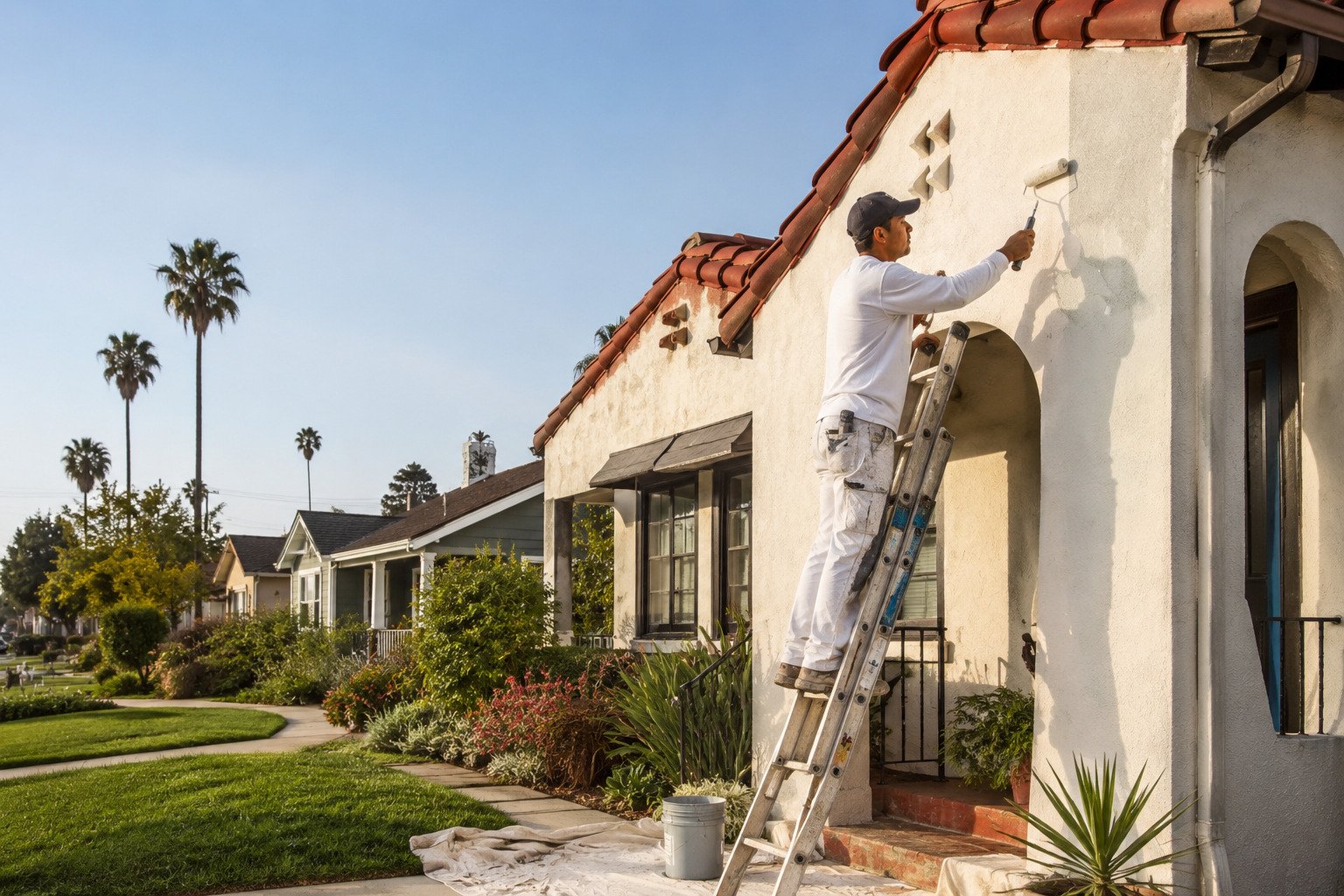
South and west elevations fail years before the north side of the same building. The north wall of a Naples house can still look acceptable when the south wall is powdering off, so there is no single right product for a whole coastal house.
| Exposure | What it takes | What we specify |
|---|---|---|
| South and west walls | Full UV load plus salt deposition | High-build or elastomeric system, heaviest film, UV-stable topcoat |
| North and east walls | Shade, slower dry after marine layer mornings | Breathable finish, mildew-resistant, standard film build |
| Water-facing trim and fascia | Salt spray, wind-driven moisture, movement | Flexible caulking, alkyd or oil primer, hard enamel finish |
| Railings, gates and ironwork | Chloride-driven rust under the coating | Wire and mechanical de-rust, direct-to-metal primer, enamel topcoat |
| Original lime stucco near the water | Salt plus trapped vapour | Breathable mineral or lime system, never a sealed acrylic film |
| Cement stucco with hairline cracking | UV plus movement | Crack treatment then elastomeric bridging system |
Repaint cycles follow the same logic. Homes in Belmont Shore, Naples, Alamitos Beach and Bluff Park run a shorter exterior cycle than the same house in an inland tract like Lakewood. Owners on the water plan for it. Owners who do not plan for it end up paying for prep instead of paint.
03
Rinsing and salt removal comes first
You cannot coat over chloride and expect adhesion.
More than a quick pressure wash
Every coastal repaint we do starts with a thorough fresh-water rinse and wash to pull salt deposits off the substrate, followed by drying time that the marine layer schedule actually allows.
On a heavily loaded elevation it means a rinse, a wash with the appropriate cleaner, another rinse, and a check that the surface is genuinely dry before primer. Skipping it produces the blistering and peeling the trade attributes to improper surface treatment before application and to moisture already present in the substrate.
Metal gets its own sequence
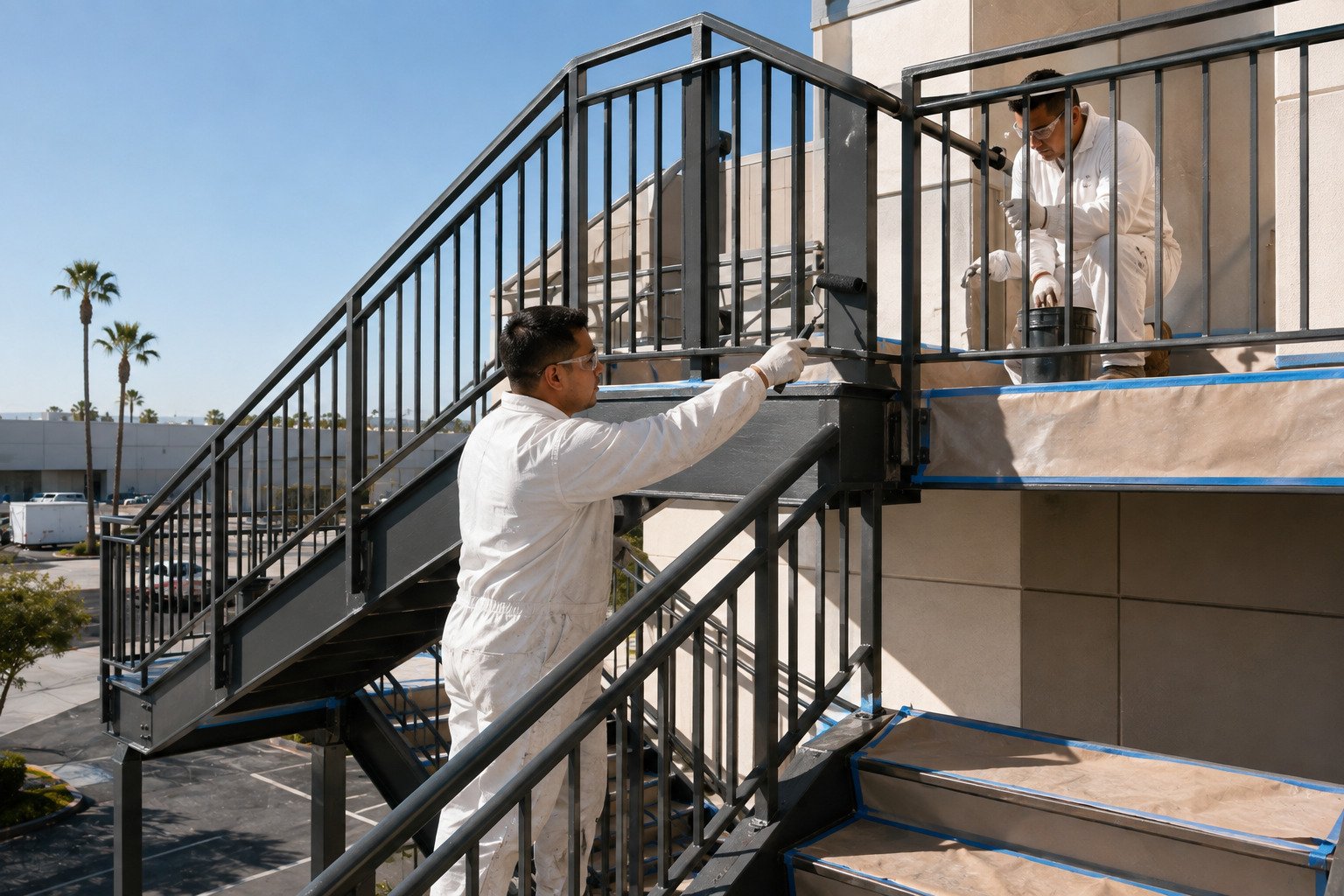
Rust is taken back mechanically to sound metal, spot-primed with a direct-to-metal primer, and finished with a hard, glossy enamel that sheds salt rather than holding it. Railings, gates and window grilles are scoped by linear footage and by how far the corrosion has already gone.
Elevation survey
We walk all four sides separately, test for chalking by hand, check adhesion, and note which walls are carrying salt load and which are not.
Written estimate by elevation
The scope names what each side gets, because the south wall and the north wall are not the same job.
Rinse and wash
Fresh water, appropriate cleaner, full salt removal, and drying time built into the schedule.
Repair and prep
Wood repair, caulking, rust treatment on all exterior metal, bonding primer over chalked surfaces.
Coating
Marine-grade and high-build systems where exposure demands them, breathable systems where the wall requires vapour to move.
Final walk
We walk every elevation with you, not just the front.
04
What shapes your estimate on a water-side house
On coastal work the variable that moves the number most is how much salt-driven damage is already under the film.
- Corroded fasteners holding trim, gutters and railings, which have to be replaced rather than coated.
- Rusted railings and gates, scoped by linear foot and by depth of corrosion.
- Chalked substrate that needs a bonding primer before a finish coat will grip it at all.
- Wood that has been wet at 6 a.m. every day for a decade, which usually means consolidation or replacement at the ends and joints.
- Access, since oceanfront lots are frequently tight, tall and hard to stage.
- Drying time, which on a coastal schedule is a real cost rather than an afternoon.
05
Why coastal homeowners hire us
We specify by elevation
One product for the whole house is the easy bid and the wrong answer. The south wall is a different job.
We remove the salt
Rinsing and washing are line items in our scope, not something that happens while the crew unloads.
We treat the metal properly
Railings, gates and hardware get de-rusted and direct-to-metal primed, because that is where a coastal repaint fails first.
We tell you the cycle honestly
A house in Naples will want attention sooner than the same house in Lakewood, and we would rather you plan for it than be surprised.
06
Frequently asked questions about coastal repainting
How long does it take?
Most single-family coastal exteriors run one to three weeks. Rinsing, salt removal and drying time add days that an inland job does not need, and we schedule around marine layer mornings rather than coating a damp wall.
How often will I need to repaint near the water?
Shorter than inland, and it varies by elevation. South and west walls in Belmont Shore, Naples, Alamitos Beach or Bluff Park generally want attention several years ahead of a comparable house in Lakewood. The north side often has years left when the south side is done.
Will the prep damage my stucco or siding?
No. We use controlled washing rather than aggressive high-pressure blasting, which erodes soft stucco and drives water into siding joints. On original lime stucco we keep pressure low and stay with breathable systems.
Do you use marine-grade coatings?
On exposures that need them, yes, along with high-build and elastomeric systems. On a breathable original wall a heavy film would be the wrong call, so the specification follows the substrate and the exposure rather than a single product line.
Can you work with my designer or architect on colour?
Yes. We take colour and sheen direction, put samples on the actual elevations so you can see them in coastal light, and note where a dark colour on a south wall will fade faster.
Do you handle the railings and gates too?
Yes. Exterior metal is part of the scope on this work rather than an add-on, because chloride-driven rust under the coating is one of the first things to fail on a water-side property.
Do you offer free written estimates on coastal exterior repainting?
Yes. We walk every elevation, test for chalking and adhesion, and provide an itemised written estimate at no charge. Call (562) 269-1108.
My neighbour’s repaint failed in three years. Why?
Almost always salt left on the wall, a film applied over chalk without a bonding primer, or one product used on all four elevations. Coastal failures are prep failures far more often than product failures.
Is your crew licensed and insured for coastal exterior repainting?
Yes. We are fully licensed, insured and bonded, with a certificate of insurance available on request.
What warranty comes with coastal exterior repainting?
We warranty our workmanship, and manufacturer warranties on the coatings apply separately. Terms are written into your estimate before the crew starts.
07
Related painting services
Coastal exposure is a spectrum, and these are the neighbouring scopes.
- Exterior House Painting
- Stucco Painting
- Limewash & Mineral Coatings
- Historic Home Restoration Painting
- Venetian Plaster & Specialty Finishes
- All painting services in Long Beach, CA
Painting service areas
Coastal exposure does not stop at the city line, and neither do we.
Get your free coastal repaint estimate
Give us the address and which direction the house faces. We will walk all four elevations, check for chalking, salt load and rust, and write an estimate that treats each side as the different job it actually is.
- Free written estimate
- Scope written elevation by elevation
- Licensed, insured and bonded
Request a FREE Quote!
Or call (562) 269-1108. Calls only, we do not receive text messages.
Thank you. Your request is in. We reply the same business day, and you can always call (562) 269-1108.