
Our bathroom painting project came out beautifully. Clean edges and a flawless finish!
Ceiling Painting in Long Beach, CA
Long Beach Expert Painting is the Long Beach area's trusted expert in interior ceiling finishes, specializing in flat ceiling coats, popcorn and acoustic texture removal, and stain-blocking primer work. We offer stairwell and high-ceiling painting plus skim coating after a texture scrape.
Our team provides airless spray and back-rolled application, delivering an even, quiet plane overhead for homes and low-odor scheduling for both residential and commercial projects. Fully licensed, insured and bonded, we have finished everything from one bedroom ceiling to a two-story entry with an open stairwell.
From cutting a clean line where the ceiling meets the wall to full texture removal, skim coat and repaint, our team handles every detail. Serving Long Beach, Signal Hill, Lakewood and Bellflower, we ensure fast, efficient service and deliver reliable, professional, and clean results on every ceiling project.
Request a FREE Quote!
Or call (562) 269-1108. Calls only, we do not receive text messages.
Thank you. Your request is in. We reply the same business day, and you can always call (562) 269-1108.
- Sprayed and back-rolled, no lap marks
- Stains blocked at source
- Popcorn removal with containment
- Licensed, insured and bonded
Reviews
What Customers Say About Our Ceiling Painting Work
The ceiling painting came out smooth and even. The room feels much cleaner and brighter now.
We hired the team to paint several units in our rental property. The walls, doors, and trim were finished neatly, and each space looked fresh and ready for new tenants. The results made a noticeable difference.
Our commercial storefront needed an update, and Long Beach Expert Painting delivered exactly what we wanted. The new color scheme looks clean and professional, giving the building a much stronger street presence.
We had peeling paint and minor surface damage on the outside of our home. The team prepared the problem areas carefully before applying the new paint. The finished exterior looks smooth, durable, and professionally restored.
Great work on our doors, baseboards, and interior trim. Every line looks crisp and precise.
Long Beach Expert Painting transformed our older home with fresh interior and exterior paint. The preparation work was thorough, the color coverage was consistent, and the finished surfaces look outstanding. The entire property now feels well maintained and updated.
Long Beach Expert Painting did a beautiful job repainting the interior of our home. The rooms look brighter, cleaner, and completely refreshed.
01
Ceilings are the least forgiving surface in the house
A ceiling is a single uninterrupted plane lit from the side by every window and fitting in the room. Roller laps, patch flashing and thin coverage that would never show on a wall are obvious overhead, which is why method matters more than product here.
What we fix overhead
Nobody scuffs a ceiling with a chair, and yet it is the first surface a guest notices from a couch in a Bixby Knolls living room.
- Dull, yellowed flat paint, especially on kitchen ceilings that collect cooking residue.
- Water stains from a roof leak, an upstairs bathroom or a failed supply line.
- Popcorn and acoustic texture, scraped and refinished or painted in place.
- Seam cracks and nail pops, common in the older stock north of Wardlow Road.
- High ceilings and stairwells, where the problem is reaching the surface safely.
Why ceilings get flat paint
Flat is the standard for a reason, and the reason is physics rather than tradition. Flat scatters light instead of reflecting it, so a taped seam or a hairline patch stops reading as a line and starts reading as ceiling. That matters more overhead than anywhere else, because a ceiling takes raking light, meaning light traveling almost parallel to the surface. Every window throws raking light across the ceiling for part of the day, and any sheen at all chases that light and hands you a map of the drywall work underneath.
Why we spray and back-roll
Spraying puts an even film across a large plane without the start-and-stop that produces lap marks, and back-rolling pushes it into a textured surface so there are no shadowed low spots. Rolling alone on anything above a small room leaves a visible grid of overlaps once the afternoon light comes across it.
Containment first
Overhead work drops. Floors, furniture, fittings and doorways are covered and sealed before a nozzle is opened, and light fittings and fans come down or are bagged rather than cut around. Done properly, no overspray leaves the room being worked.
Ceilings show their history
Old leaks, previous patches, acoustic texture applied over a bad joint, and in Long Beach's older stock lath and plaster under later board. We identify what is up there before quoting, because a plaster ceiling with hollow areas is a different job from a flat board ceiling.
02
What kind of ceiling do you have?
Six types cover almost everything we find between pre-war Bluff Park bungalows and 1990s Cerritos tract housing, and they need different handling.
| Ceiling type | Where it turns up | Common problem | Our approach |
|---|---|---|---|
| Smooth drywall | Later construction and remodelled rooms | Shows every joint and patch | Level 5 skim where needed, prime, spray dead flat |
| Orange peel or knockdown | 1980s onward tract housing | Patches in a mismatched texture | Match texture, prime the repair, spray and back-roll |
| Acoustic popcorn | 1960s to early 1980s housing | Discoloured, sheds, dated, absorbs stains | Removal and smooth refinish, or careful coating if it stays |
| Hand-trowelled plaster | Pre-1940 Long Beach bungalows and Spanish Revival | Hairline crazing, hollow areas, past repairs | Consolidate and repair first, then brush and roll rather than heavy spray |
| Wood plank and beadboard | Porches, older kitchens, additions | Paint filling the joints, tannin bleed | Stain-blocking primer, keep the joint lines open |
| Suspended tile grid | Offices, retail, medical suites | Stained tiles, yellowed grid | Coat or replace tiles, spray grid separately, covered under commercial interiors |
Sheen, and where each one belongs
Flat hides the most and cleans the least, so in a bathroom we push you toward matte or satin and accept that the surface underneath has to be flatter to begin with. Eggshell and above belong on coffered detail and beams, never on the open field of a ceiling, because moderate sheen shows lap marks and semi-gloss reflects hard enough to trace every fastener.
03
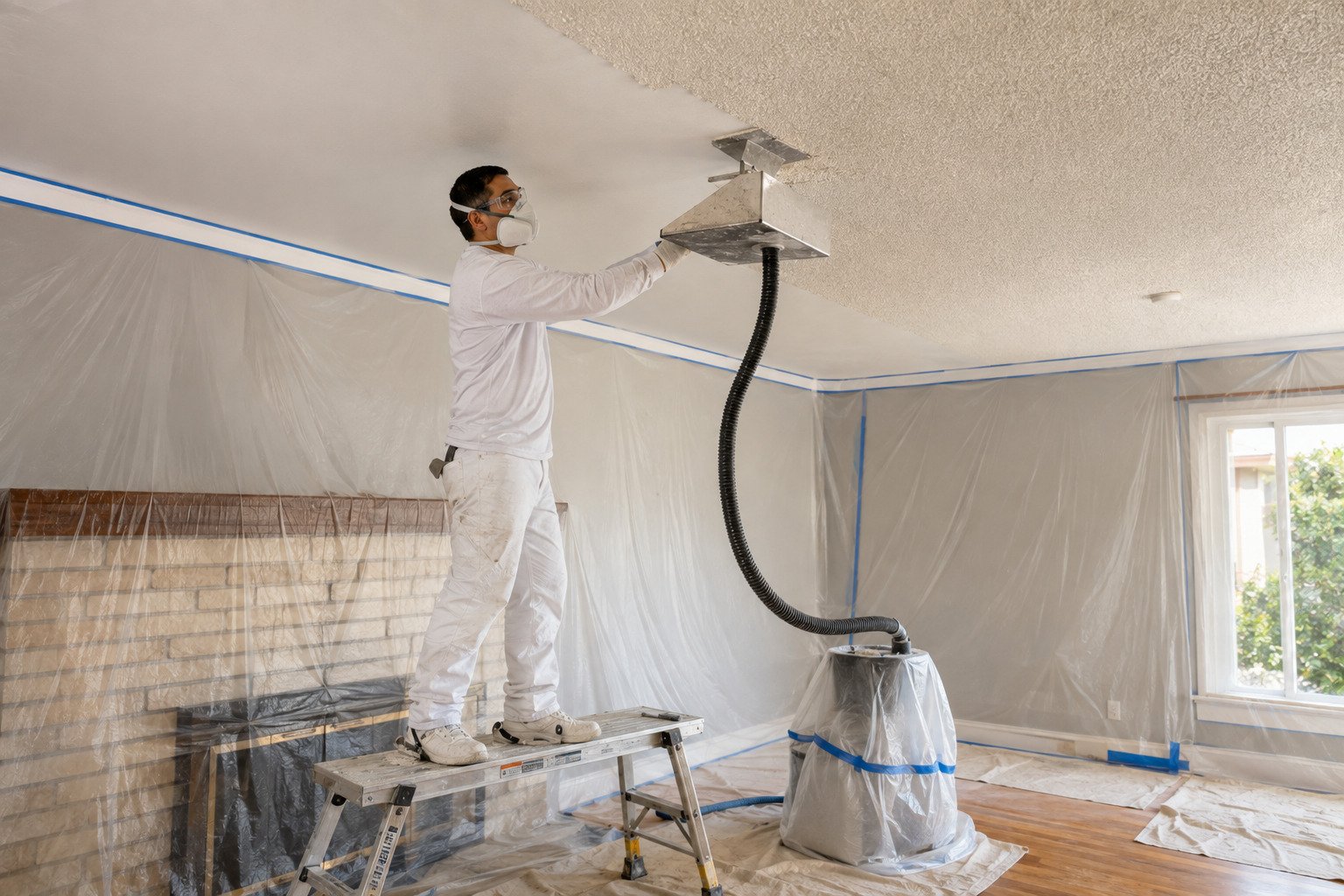
Popcorn ceiling removal, step by step
Acoustic texture is the most common ceiling request we get in 1960s and 1970s housing across Lakewood, Cypress and North Long Beach. Sprayed acoustic texture went on millions of ceilings and a lot of Long Beach homes still carry it, so you have two honest options.
Scrape it. The texture is soaked, scraped wet, then the exposed drywall gets skim coated, sanded, primed and painted. This is the finish most people want, and it costs more because the surface underneath is almost never flat enough to leave alone.
Paint it in place. Texture sprays well with flat ceiling paint. It refreshes the colour, kills a stain, and costs a fraction of removal. It also locks the texture on permanently.
The age of the house decides which conversation happens first. On anything built before 1978 we treat the ceiling as presumed lead-containing and work under lead-safe practices, with containment, wet methods and controlled cleanup. That is standard across the older stock in Los Cerritos, Carroll Park and Bluff Heights.
Test before touching it
Acoustic texture applied before the early 1980s can contain asbestos. It is sampled and tested by a lab before any scraping, and if it is positive the work goes to a licensed abatement contractor rather than to us. This is not negotiable and no reputable painter will skip it.
Seal the room
Floors covered, walls protected, doorways sealed, fittings removed. Scraped texture is wet and heavy and it goes everywhere it is allowed to.
Wet and scrape
The texture is misted so it releases without gouging the paper face of the board underneath, then scraped in sections. A painted popcorn ceiling resists water and takes longer, which is a cost factor we identify before quoting.
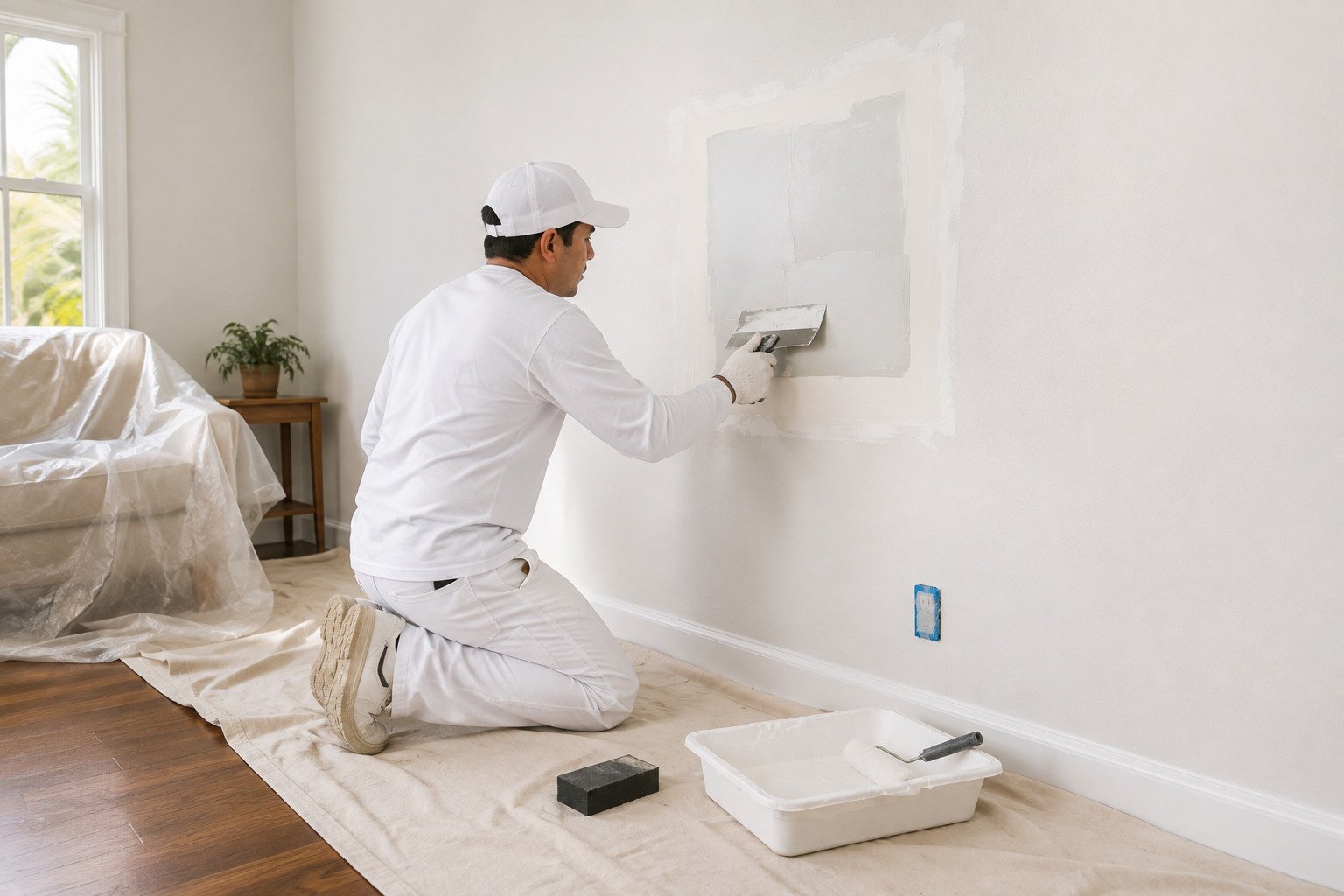
Repair and skim
Scraping reveals the original joints, and they are usually finished only to a Level 3 because the texture was hiding them. Joints are re-finished, damage repaired, and the ceiling skimmed to the smoothness you have chosen.
Prime the whole plane
Fresh compound and exposed board absorb differently, so the ceiling is primed in full rather than spot-primed. Old stains are blocked at this stage.
Spray the finish
Two coats of dead flat, sprayed and back-rolled where texture remains. Fittings reinstated, room cleared, floors cleaned.
04
Stains, and why they come back
A ceiling stain is a report on something else. Painting it without dealing with the cause and the chemistry guarantees it returns, usually within weeks.
Water stains carry dissolved minerals and tannins that migrate straight through a water-based finish, which is why a stain painted with two coats of ceiling white reappears as a brown halo. Two coats, three coats, it makes no difference. The sequence that works is: confirm the leak is fixed and the substrate is dry, replace board that stayed wet, block the stain with a shellac or oil-based stain-blocking primer, then coat the full plane so the repair does not read as a patch. We will not coat a stain that is still damp, since painting over moisture in the substrate is the direct cause of blistering and peeling later.
Smoke and nicotine staining behaves the same way and needs washing before blocking, because the residue itself is greasy. Rust marks from fasteners need the fastener treated, not just covered. In kitchens, a yellowed ceiling above a range is usually a film of cooking oil rather than a stain at all, and it has to be degreased or nothing will bond to it.
Height, stairwells and access
A stairwell is the hardest interior surface in a house to paint properly. The floor is not level, the walls run two stories, and the ceiling sits over a drop. That takes scaffold or a correctly set plank-and-ladder system, which is why a stairwell carries its own estimate line instead of folding into a room count.
05
What shapes your estimate, and how we work
Four things move a ceiling number more than anything else. We look at all four during the walkthrough, then put the scope in writing.
What shapes the estimate
- Ceiling height. Eight feet is a roller pole. A vault or a stairwell is staging.
- Texture. Flat drywall, orange peel, knockdown and acoustic texture take different labour and material.
- Repairs. Skim coating, seam repair and texture matching are separate from painting.
- Stains and coats. Spot priming is quick, a whole-ceiling stain block is another full coat, and a yellowed kitchen ceiling needs more than one pass.
Our process
- Walkthrough. Height, texture type, stain source, drywall condition, year built.
- Written estimate. Prep, repairs, primer, product, coat count and exclusions, itemised.
- Protection. Floors, furniture, fixtures and doorways covered.
- Repairs and prep. Scrape, skim, sand, patch, texture match, spot prime.
- Application. Cut in at the wall line, then spray, roll, or spray and back-roll.
- Cleanup and walkthrough. We walk it under the light that made you call.
What Long Beach conditions do to a ceiling
Long Beach sees 12.02 inches of rain in an average year, which is the whole problem with roof leaks here. The window in which a leak reveals itself is short, so a stain that surfaces in February may have been building quietly for two seasons. We look for the source before sealing anything. The marine layer does the rest: coastal humidity slows dry time in a closed-up interior and keeps bathroom ceilings damp longer than homeowners expect, which is why we specify a washable matte or satin in wet rooms and ventilate hard while a flat coat sets.
One sequencing note. If walls are in scope, the ceiling gets painted first. Ceiling work drips and oversprays, and a cut line at the wall junction is far easier to correct with fresh wall paint over it than the reverse.
06
Frequently asked questions about ceiling painting
Can popcorn texture just be painted instead of removed?
Yes, and sometimes that is the sensible option. Coating stabilises a shedding texture and freshens a discoloured one. It has to be sprayed, because a roller pulls the texture off, and once it has been painted a future removal becomes considerably harder because the water cannot get into it. If removal is on your list at all, do it before coating.
Do ceilings need two coats?
Nearly always. One coat over a previously painted ceiling in the same colour can pass in a small room with even light, but on any large plane the second coat is what evens the film and kills the patchiness. Over new board, new texture or a blocked stain, two coats is the minimum.
Should the ceiling be a different white from the walls?
Usually yes, and often just a shade cleaner. Dead flat ceiling white against an eggshell wall reads as a deliberate separation even when the colours are close. Painting ceiling and walls the same colour and sheen is a legitimate contemporary look, but it demands a much better ceiling surface because nothing is hiding.
Can you paint around a ceiling fan and recessed lights?
We take them down or bag them properly rather than cutting around them. Cutting in around a fan canopy or a trim ring leaves a visible line and always ends up with paint on the fitting. Fittings come off, the plane is coated as one surface, then everything goes back.
How do you handle a ceiling in a two-storey stairwell?
With proper access rather than a ladder and optimism. Scaffold or a tower, floors and treads protected, and the work sequenced so the stairs stay usable at the start and end of each day. Stairwell ceilings and their adjoining high walls are almost always quoted together because the access is the cost.
Will you find out where a leak is coming from?
We will identify whether a stain is still active, using moisture readings, and tell you what we see. Tracing and repairing a roof, flashing or plumbing failure is another trade, and we would rather refer it and come back than coat over an active leak and have you call us in six weeks.
How fast can you get here?
Most ceiling jobs start within one to two weeks. A single stained ceiling is often quicker, since it does not need a full crew.
Do you cover my ZIP code for ceiling painting?
We cover Long Beach ZIP codes 90802 through 90815, plus 90810 in West Long Beach and 90755 in Signal Hill, along with Lakewood, Bellflower and Paramount.
Do you move furniture before ceiling painting starts?
We move what can be safely moved, shift large pieces to the centre of the room and sheet them. Clear small items and breakables first.
What preparation is included in a ceiling painting estimate?
Masking and floor protection, patching and nail-pop repair, sanding, texture matching, and spot or full stain-blocking primer. Heavy skim coating or panel replacement is itemised separately.
07
Related painting services
Ceiling work shares its access and masking with these, so booking them together saves a whole setup.
- Drywall Repair & Painting
- Interior House Painting
- Wallpaper Removal & Repainting
- Kitchen Cabinet Painting
- Venetian Plaster & Specialty Finishes
- All painting services in Long Beach, CA
Painting service areas
The same crews and the same specification standards across ten cities around Long Beach.
Get your ceilings quoted, including the texture question
Tell us the era of the house and what the ceiling is doing. We will tell you whether it needs coating, skimming or removal.
- Free written estimate
- Asbestos testing before any texture removal
- Licensed, insured and bonded
Request a FREE Quote!
Or call (562) 269-1108. Calls only, we do not receive text messages.
Thank you. Your request is in. We reply the same business day, and you can always call (562) 269-1108.