
Excellent painting and careful preparation. Our house looks amazing!
Historic Home Restoration Painting in Long Beach, CA for Period Houses and District Properties
Long Beach Expert Painting is the Long Beach area's trusted expert in historic restoration painting, specializing in breathable lime and mineral coating systems, lead-safe surface preparation, and sash and trim restoration. We offer gilding, distemper and faux finishes including marbleizing and graining.
Our team provides period-correct colour and finish specification, delivering wall systems that let original masonry dry for homes and documented scopes that hold up in design review for both residential and commercial projects. Fully licensed, insured and bonded, we have restored everything from a single checked porch column to a full two-story exterior.
From consolidating a split redwood sash to a complete exterior specified elevation by elevation, our team handles every detail. Serving Long Beach, Signal Hill, Seal Beach and Lakewood, we ensure careful, unhurried service and deliver reliable, professional, and period-faithful results on every restoration project.
Request a FREE Quote!
Or call (562) 269-1108. Calls only, we do not receive text messages.
Thank you. Your request is in. We reply the same business day, and you can always call (562) 269-1108.
- Lead-safe containment on pre-1978 stock
- Breathable systems on original walls
- Sample panels on the building
- Licensed, insured and bonded
Reviews
What Customers Say About Our Historic Home Restoration Painting Work
We hired Long Beach Expert Painting to repaint our living room, kitchen, and hallway. The lines around the trim and ceilings came out incredibly clean, and the new colors transformed the entire space. Everything was left neat when the work was finished.
Our home’s exterior looks brand new again. The finish is smooth, even, and professionally done.
The team painted our kitchen cabinets, and we couldn’t believe the difference. The doors and drawers have a smooth, factory-like finish, and the new color made our entire kitchen feel more modern.
Friendly service, beautiful results, and great attention to detail.
Long Beach Expert Painting repaired several damaged areas of drywall before repainting our bedroom. The repaired sections blend perfectly with the surrounding walls, and the finished room looks clean and polished.
The exterior paint had faded badly from years of sun exposure. After the project was completed, our home had stronger curb appeal and a fresh, updated appearance. The trim work looks especially sharp.
Our bathroom painting project came out beautifully. Clean edges and a flawless finish!
01
What restoration painting covers on an older Long Beach house
Restoration is not a repaint with better tape. Scope is set by what the house is made of and by what previous owners already put on it.
Exterior and windows
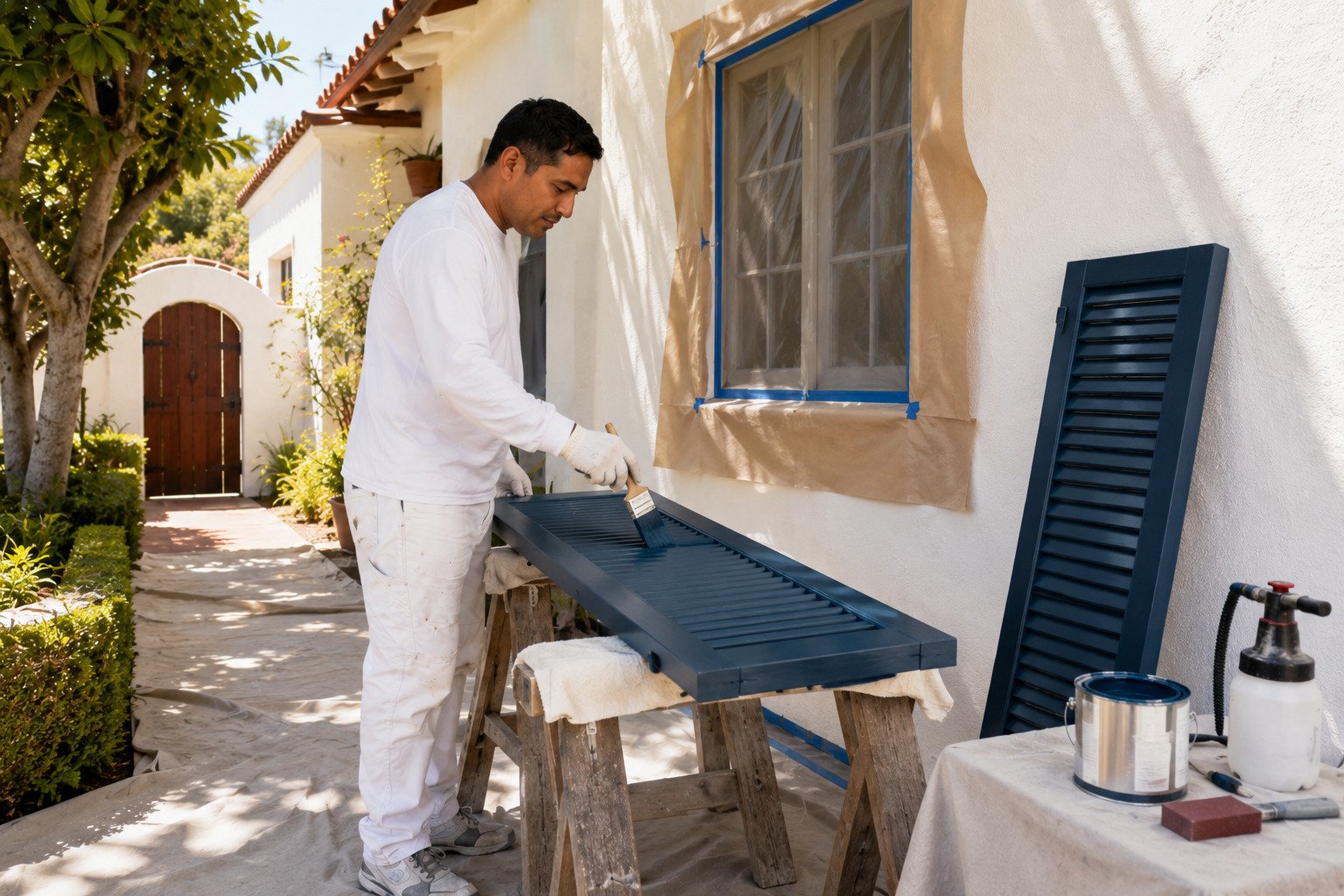
Exterior. Hand and heat removal where appropriate, consolidation of split wood, epoxy or dutchman repair to sills, columns and rafter tails, and a coating system matched to the permeability of the original wall.
Windows and sash. Sash removal, glazing putty replacement, muntin and rail repair, priming bare wood on all six sides, and rehanging with functional weights and cords where the original hardware survives.
Interior and ironwork
Interior. Millwork and trim finishing, door and jamb refinishing, and period finishes a general repaint crew does not carry: gilding on mantel detail, distemper on plaster ceilings, marbleizing on columns and fire surrounds, graining on softwood doors meant to read as quartersawn oak.
Ironwork. Balcony rail, gate and window grille work taken back to sound metal and recoated, scoped by linear footage and by how much rust is already present.
02
The 18 designated historic districts and the Certificate of Appropriateness
Exterior modification inside a designated district requires a Certificate of Appropriateness from the city, and colour and material can both fall under that review. We plan around it rather than discovering it halfway through.
| District | Designated | Predominant styles |
|---|---|---|
| Bluff Park | 1982 | Two-story Craftsman Bungalow and Period Revival, 1903 to 1949 |
| Wrigley Area | 1989 | Spanish Colonial Revival and other Period Revival |
| Minerva Place | 1989 | Spanish Colonial Revival |
| Carroll Park | 1990 | California Bungalow plus 16 other styles, Colonial Revival and Queen Anne included |
| Sunrise Boulevard | 1990 | Craftsman Bungalow and Spanish Colonial Revival, 1924 to 1928 |
| Hellman Street Craftsman | 1992 | Craftsman Bungalow, gabled roofs, open porches |
| Lowena Drive | 1992 | Medieval Revival, Chateauesque, Tudor Revival |
| Brenner Place | 1994 | Spanish Colonial Revival |
| Linden Avenue | 1994 | Period Revival, vernacular Craftsman, Greek Revival, American Foursquare |
| Wilton Street | 1995 | Spanish Colonial Revival with Mission Revival overtones |
| Rose Park | 1997 | Craftsman Bungalow 1910 to 1922, Victorian, Spanish Colonial Revival |
| Drake Park / Wilmore City | 1998 | Victorian, Craftsman, Mission, Prairie, Italian Renaissance |
| California Heights | Expanded 2000 | Spanish Colonial Revival predominates, Tudor and Norman Revival |
| Rose Park South | 2001 | Craftsman Bungalow 1910 to 1924, Prairie and Mission Revival |
| Belmont Heights | 2002 | Craftsman Bungalow predominates, Victorian, Mission and Tudor Revival |
| Eliot Lane | 2003 | Mission Revival |
| Bluff Heights | 2004 | Craftsman Bungalow 1910 to 1923, Victorian, Prairie, Mediterranean |
| Grant Neighborhood | 2019 | Spanish Colonial Revival influenced, English Revival, Storybook, Ranch |
California Heights
The district we get called into most. Developed between 1925 and 1927, built out by 1939, and a local historic district since 1990. It runs roughly between San Antonio Drive, Atlantic Avenue, Wardlow Road and Long Beach Boulevard. Spanish Colonial Revival dominates, which means original permeable stucco, and that single fact rewrites the coating specification.
03
Why a modern acrylic film fails on an original wall
This is the most expensive mistake made on old Long Beach houses, and it usually happened two owners ago.
The wall was built to pass vapour
Traditional lime stucco is highly permeable. It balances humidity almost as well as clay, and because lime is faintly water soluble it self-heals slightly as deposits resolidify inside hairline cracks.
Put a modern acrylic film over it and the vapour has nowhere to go. Blistering and peeling follow, which the trade attributes to improper surface treatment before application and to moisture already present in the substrate. Five years on, the coating comes off in sheets and takes original finish with it. The answer is not a tougher paint. It is the right permeability.
Lead-safe practice on pre-1978 housing
Anything built before 1978 is treated as lead-bearing until proven otherwise, and most housing in these districts predates that line by fifty years. That means containment, wet methods, no open dry sanding of intact coatings, and HEPA cleanup.
It has a budget consequence, and on a house carrying eight coats of history it is the largest single line in the estimate. A bid that ignores it is not cheaper, it is incomplete. Encapsulation often beats removal: sound coating stabilised under a compatible system disturbs far less material than stripping to bare wood.
| Original substrate | System we specify | Why it works |
|---|---|---|
| Original lime stucco | Limewash or silicate mineral paint | Passes vapour, bonds by absorption and carbonation rather than by film |
| Brick and unpainted masonry | Limewash | Absorbed easily, and the resulting chemical reaction hardens the medium |
| Cement stucco added later | Mineral or elastomeric, depending on cracking | Cement stucco is hard and brittle and separates when the base moves |
| Original wood siding and trim | Oil or alkyd primer under an acrylic finish | Oxidative crosslinking on bare wood, flexible topcoat above it |
| Interior plaster | Distemper or a breathable flat | Keeps the plaster working, and it is correct for the period |
| Exterior ironwork | Direct-to-metal primer with a hard enamel | An especially hard, usually glossy finish that resists coastal rust |
Cement additives in a limewash restrict breathability and are inadvisable on a preserved historic building. We do not use them on district work.
04
Our process, and what shapes your estimate
Three things drive the number: how many coats of history sit on the surface, how much original material gets repaired rather than replaced, and how much of the job is hand work.
Walkthrough and paint history
We test adhesion, check for chalking and trapped moisture, and identify the original substrate under the additions.
District check
Inside a designated district, we confirm what the Certificate of Appropriateness process requires before colour and material go into the estimate.
Written estimate
Itemised by elevation and element, with the lead-safe, repair and coating lines shown separately.
Containment and prep
Ground protection, containment where pre-1978 coatings are disturbed, hand scraping and wet methods.
Mock-up
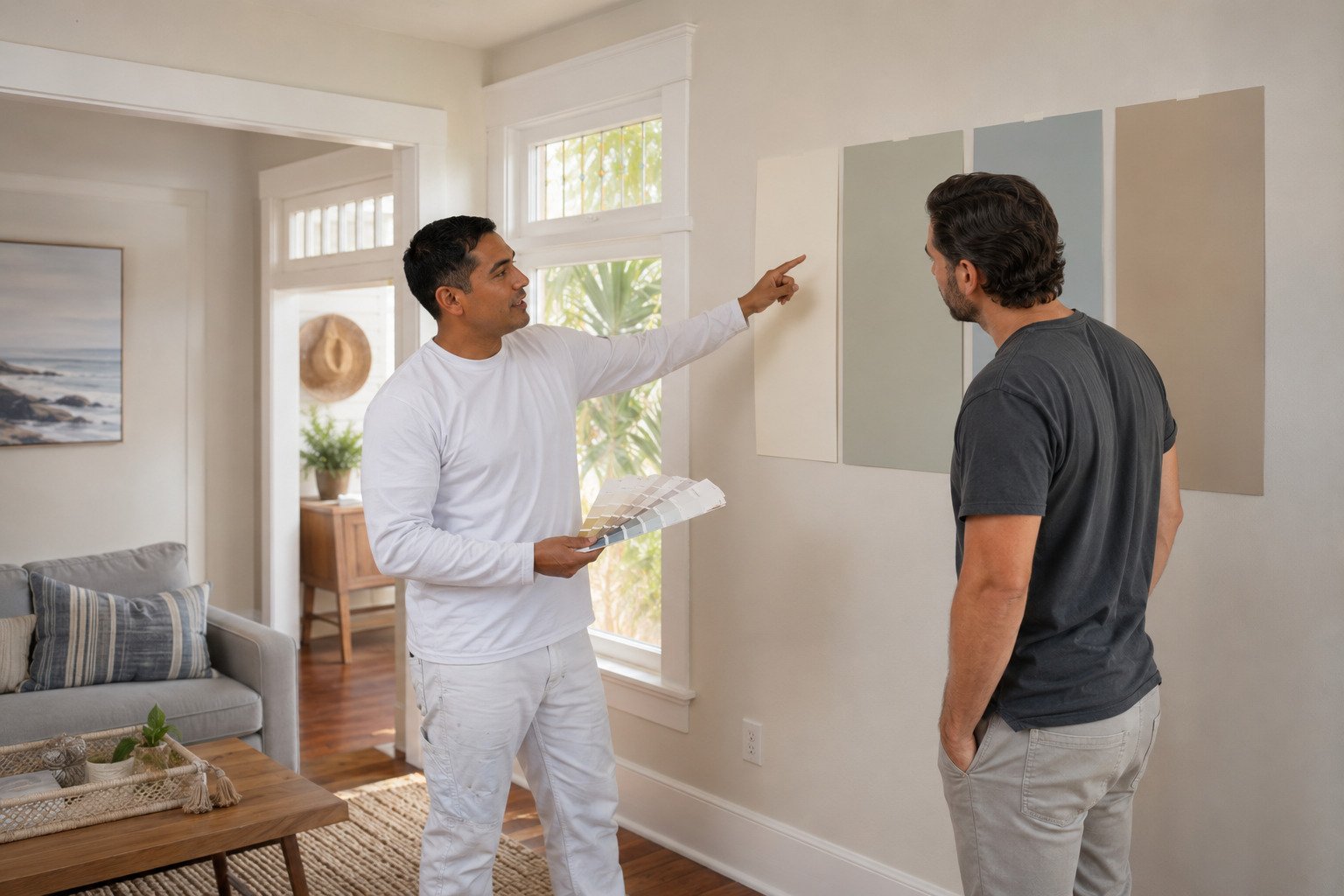
On lime and decorative work we put a sample panel on the building itself and let you approve it in daylight.
Application
Brushed where the period demands it, multiple thin coats on lime, burnished or laid off as the finish requires.
Final walk
We walk it with you and correct the punch list before demobilising.
05
What Long Beach conditions do to a period house
Long Beach gets 12.02 inches of rain a year and a great deal of sun in between.
Sun, then salt
That combination powders coatings from the surface down, the failure the trade calls chalking, assessed per ISO 4628 Part 6. South and west elevations reach it years ahead of the north side of the same house.
Add the marine layer off San Pedro Bay. Salt travels inland, settles on the film and holds moisture against it, turning ordinary chalking into erosion. On a 1920s house with a permeable wall, that moisture has to be able to leave. Bluff Park, Bluff Heights and Belmont Heights feel this hardest. Inland districts such as the Wrigley Area trade some salt load for more direct UV.
Why owners of older homes hire us
We read the wall before we quote it. A 1925 Spanish Colonial Revival in California Heights and a 1958 stucco tract house do not take the same product, and pricing them alike is how houses get ruined.
We slow down on prep. Hand scraping, wet methods, consolidation instead of replacement wherever original material can be saved. We do not subcontract that part.
We carry the decorative trades. Gilding, distemper, marbleizing and graining, so the mantel and the doors do not need a separate specialist.
06
Frequently asked questions about restoration painting
How long does a restoration take?
Most single-family exterior restorations run three to eight weeks. Hand work, sash repair, containment and multi-coat lime systems take real time, and lime finishes need days between coats to carbonate. You get a written schedule with the estimate.
My house is in a designated historic district. Do you handle the approval?
Exterior modification in any of the 18 districts requires a Certificate of Appropriateness. We identify what your scope triggers and prepare the material and colour information the review needs. The application itself is filed by the property owner.
Will stripping damage the original siding or stucco?
Not the way we work. We stabilise and encapsulate wherever the existing coating is sound, and where removal is necessary we use hand scraping and wet methods rather than aggressive abrasion or high-pressure blasting, which erodes soft old lime stucco permanently.
Is the work reversible?
Breathable lime and silicate systems are the closest thing to reversible on a masonry wall, which is exactly why a preservation-minded owner wants them. We do not add cement to limewash on district property, because that restricts breathability and is inadvisable for preserved historic buildings.
How often will it need recoating?
A breathable lime system wears rather than fails and generally wants attention every five to seven years on the exposed elevations, less on the north side. A properly primed wood siding restoration typically goes seven to ten years here, shorter on a south or west wall near the water.
Can you work with my architect or designer?
Yes, and it is the normal case here. We take direction on colour, sheen and finish, provide sample panels on the building for approval, and give you a specification you can hand to a preservation consultant.
Do you offer free written estimates on historic restoration painting?
Yes. We walk the property, review the paint history and the substrate, and provide an itemised written estimate at no charge. Call (562) 269-1108.
Can original windows be saved rather than replaced?
Almost always. A checked or split sash can be consolidated, repaired with a dutchman and reglazed, and the original wood is generally better than what a replacement would be made from.
Do you do interior decorative work on its own?
Yes. Gilding, distemper, marbleizing and graining are scoped as their own project when the exterior is not due.
What warranty do you provide?
We warranty our workmanship, and manufacturer warranties on coatings apply separately. Terms appear in your written estimate before any work begins.
07
Related painting services
Restoration jobs usually pull in two or three of these.
- Limewash & Mineral Coatings
- Venetian Plaster & Specialty Finishes
- Marine & Coastal Exterior Repaint
- Brick & Masonry Painting
- Exterior House Painting
- All painting services in Long Beach, CA
Painting service areas
We work throughout Long Beach and the surrounding cities on older and higher-end property.
Get your free restoration painting estimate
Give us the address, the district if you are in one, and whatever you know about the paint history. We will walk the house and write an itemised estimate with the repair, lead-safe and coating scopes shown separately.
- Free written estimate
- Lead-safe scope shown as its own line
- Licensed, insured and bonded
Request a FREE Quote!
Or call (562) 269-1108. Calls only, we do not receive text messages.
Thank you. Your request is in. We reply the same business day, and you can always call (562) 269-1108.