
The painters took great care around our furniture, flooring, and fixtures. Our walls and ceilings look fantastic, and there were no drips or messy edges left behind.
Limewash and Mineral Coatings in Long Beach, CA for Breathable Stucco and Masonry Walls
Long Beach Expert Painting is the South Bay's trusted expert in lime-based and mineral coating work, specializing in traditional limewash, silicate mineral paint, and breathable systems for original stucco and brick. We offer sample panel mock-ups and full colour development on site.
Our team provides substrate testing and damping control before a drop of material goes on the wall, delivering a finish that ages instead of failing for homes and a maintainable specification for both residential and commercial projects. Fully licensed, insured and bonded, we have coated everything from a single garden wall to a whole-house lime exterior.
From damping a thirsty brick face so the wash does not go powdery to laying multiple thin coats and letting each one carbonate, our team handles every detail. Serving Long Beach, Signal Hill, Cerritos and Seal Beach, we ensure careful, patient service and deliver reliable, professional, and beautifully weathered results on every lime and mineral project.
Request a FREE Quote!
Or call (562) 269-1108. Calls only, we do not receive text messages.
Thank you. Your request is in. We reply the same business day, and you can always call (562) 269-1108.
- Absorption tested before we specify
- Substrate damped, never rushed
- No cement in the mix on district property
- Licensed, insured and bonded
Reviews
What Customers Say About Our Limewash & Mineral Coatings Work
Our new accent wall looks perfect. It completely changed the feel of the room.
Long Beach Expert Painting helped us choose colors that complemented our flooring and natural lighting. The finished interior feels warm, coordinated, and much more inviting. We are extremely happy with the transformation.
Beautiful exterior painting and excellent workmanship from beginning to end.
We hired the team to paint several units in our rental property. The walls, doors, and trim were finished neatly, and each space looked fresh and ready for new tenants. The results made a noticeable difference.
Our commercial storefront needed an update, and Long Beach Expert Painting delivered exactly what we wanted. The new color scheme looks clean and professional, giving the building a much stronger street presence.
The ceiling painting came out smooth and even. The room feels much cleaner and brighter now.
We had peeling paint and minor surface damage on the outside of our home. The team prepared the problem areas carefully before applying the new paint. The finished exterior looks smooth, durable, and professionally restored.
01
What limewash actually is
Limewash is made from slaked lime, which is calcium hydroxide, or from chalk, which is calcium carbonate. It is not paint in the modern sense and it does not behave like paint.
It cures rather than dries
A modern acrylic adheres to the surface. Limewash is drawn into the substrate. It cures by carbonation, reacting with atmospheric carbon dioxide to form calcium carbonate as calcite, so the finish hardens over days and weeks rather than drying in an afternoon. Opacity increases as it dries, then increases again as it cures, which is why a first coat that looks alarmingly thin on Tuesday looks correct by the weekend.
Why damping is not optional
That absorption is also why the substrate has to be damped before application. Dry masonry pulls the water out too fast, the lime never gets the moisture it needs to bond, and the finish goes powdery and rubs off on your hand. Damping controls the rate. It is the single most skipped step on this work.
Limewash is especially compatible with masonry, because it is absorbed easily and the resulting chemical reaction hardens the medium. On 1920s brick and original lime stucco it behaves as though it belongs, because it does.
02
What limewash will not do
Honesty on this one saves everyone money.
Driven rain
Basic limewash can be inadequate at preventing rain-driven water ingress. On a sheltered Long Beach elevation in a city that gets 12.02 inches of rain a year, that is often a non-issue. On an exposed wall taking wind-driven weather off the water, it can matter, and the answer is either a silicate mineral system or a different detailing approach rather than a thicker coat of lime.
People try to solve that by adding cement to the mix. Do not. Cement additives restrict breathability, which defeats the reason you chose lime in the first place, and they are inadvisable for preserved historic buildings.
It is not a scrubbable film
Limewash chalks lightly by design. It weathers unevenly and beautifully, and it wants refreshing on a cycle rather than a strip and repaint. If you want a wall that looks identical in year one and year eight, lime is the wrong material and we will tell you so at the estimate.
Colour range is narrower
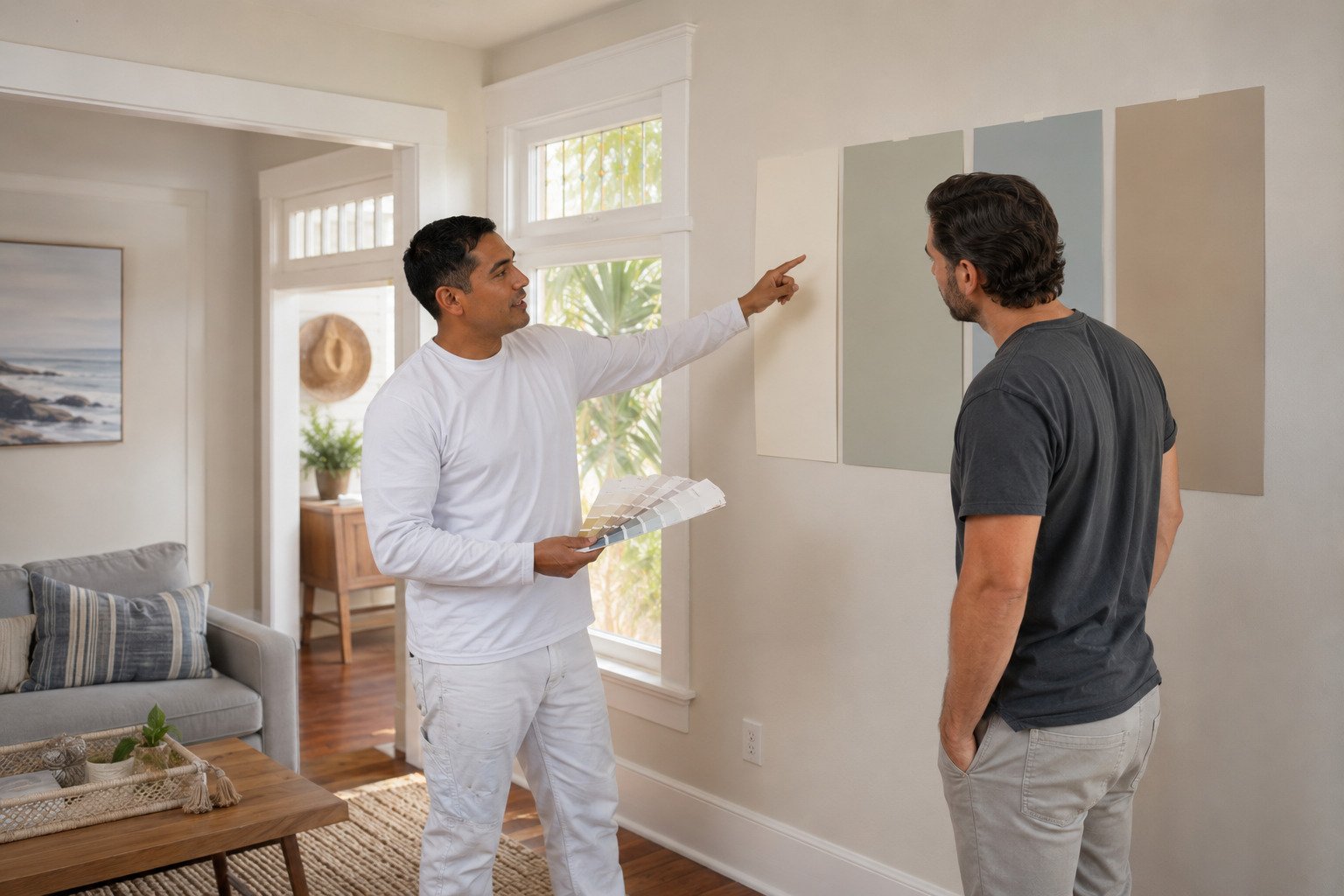
Lime is alkaline and eats some pigments, so the palette lives in earth tones, ochres, chalk whites, greys and soft pinks. We build colour on a sample panel on your actual wall, in daylight, because a lime colour chip is close to meaningless.
03
Silicate mineral paint, the modern alternative
Silicate paints are gaining ground over limewash for durability while keeping breathability. They bond chemically into a mineral substrate rather than sitting on it, so vapour still moves, but the surface is harder, more consistent in colour and better at resisting driven rain.
| Property | Limewash | Silicate mineral paint | Acrylic film |
|---|---|---|---|
| How it bonds | Absorbed into the substrate, cures by carbonation | Chemically into a mineral substrate | Adheres as a film on the surface |
| Breathability | High | High | Low, and it traps vapour on permeable walls |
| Rain-driven water resistance | Limited on exposed walls | Good | Good until the film fails |
| Appearance | Mottled, matte, alive, varies with the light | Matte and even, still mineral in character | Uniform, flat to gloss as specified |
| How it ages | Weathers and thins gradually | Fades slowly and evenly | Chalks, then blisters and peels on old stucco |
| Best on | Original lime stucco, brick, garden walls | Cement stucco, mixed substrates, exposed elevations | Modern stucco and siding with a vapour path |
| Suitable on district property | Yes, without cement additives | Yes | Not on original permeable walls |
The traditional additives
Traditional limewash recipes carry additives, and they are not folklore. Water glass, animal glue, egg white, salt, soap, milk, flour, molasses and alum have all been used to adjust set, bind pigment, harden the surface or improve water shedding. We use them selectively and we tell you what is in the mix.
The look, honestly described
Limewash is mottled and matte to the point of being nearly velvet. It moves with the light, deepens in the recesses of a brick face, and shows the brush path faintly. On a Spanish Colonial Revival elevation it reads as though the wall was always that colour. It ages rather than fails: no peeling edge, no blistering sheet, no sharp line where the coating gave up. It thins on the weather side and holds in the sheltered corners, which is the effect people are buying.
04
Why Long Beach walls suit lime
The city's older stock was built for this.
The wall wants to breathe
Traditional lime stucco is highly permeable, balances humidity almost as well as clay, and self-heals slightly because lime is faintly water soluble and deposits resolidify inside hairline cracks. Coat that wall with a modern acrylic and vapour gets trapped, which produces the blistering and peeling the trade attributes to improper surface treatment and to moisture already in the substrate.
Two local pressures
Low rainfall means long unbroken sun and steady chalking on south and west elevations. The marine layer off San Pedro Bay carries salt inland, and salt holds moisture against a wall. A breathable mineral system lets that moisture leave. A film asks it to stay.
What shapes your estimate
Square footage matters less here than substrate condition, number of coats and access. Prep moves the number more than anything: a wall carrying an old acrylic film has to have that film removed before lime will do anything at all, and that removal can cost more than the lime work itself.
Efflorescence, failing mortar that needs repointing, second-story access and a colour that needs a fourth coat all push an estimate up. We name each of those as its own line rather than folding them into a square-foot figure.
Substrate test
We check what is on the wall now, do an absorption test with water, and confirm the wall is genuinely mineral and genuinely permeable.
Sample panel
Colour and coat count get approved on your wall, in daylight, before the crew mobilises.
Preparation
Wash, remove any non-breathable coating, address efflorescence, coordinate repointing where mortar is failing.
Damping
The substrate is wetted to control absorption. This is not optional and it is why the finish does not go powdery.
Application
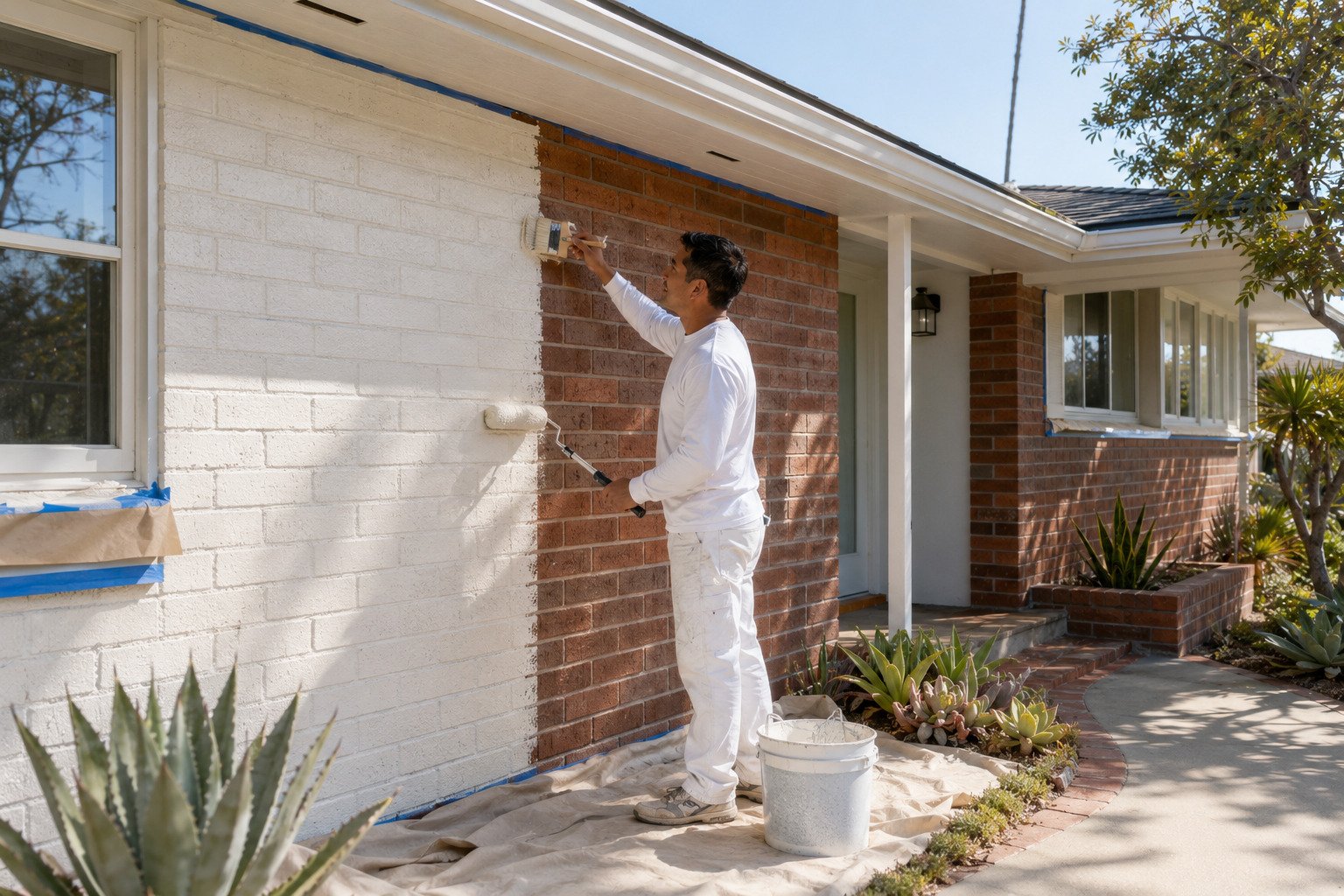
Multiple thin coats, brushed, with cure time between them. Lime rewards patience and punishes rushing.
Cure and final walk
Opacity keeps developing as carbonation proceeds, so we walk the job with you after the finish has settled rather than the hour the last coat goes on.
05
Why homeowners choose us for lime work
We test before we specify
A water absorption test takes ten minutes and settles whether lime is possible on your wall at all.
We damp the substrate properly
Powdery limewash is a preparation failure, not a product failure, and it is the most common complaint about lime work anywhere.
We tell you the limitations first
Basic limewash has limited resistance to rain-driven water. If your elevation needs more, we specify a silicate system and say why.
No cement in the mix on historic property
Cement additives restrict breathability and are inadvisable on preserved buildings, so they do not go into district work.
06
Frequently asked questions about limewash and mineral coatings
How long does the job take?
A typical house runs one to two weeks of work. Coats go on thin and need time between them, and carbonation continues after the crew leaves, so the wall keeps developing for weeks.
Can you limewash a house in a historic district?
Yes, and lime is usually the correct material there. Exterior modification in a designated district requires a Certificate of Appropriateness, so colour and material go through that review before we start.
Will it damage the original stucco or brick?
No. Lime is absorbed into the substrate and the resulting chemical reaction hardens the medium, which is the opposite of what a trapped acrylic film does to a permeable wall.
Is limewash reversible?
Practically, yes. It weathers and can be washed back or simply recoated, and it does not create the bonded plastic skin that makes removal destructive on old masonry.
How often does limewash need refreshing?
Plan on a refresh coat every five to seven years on exposed elevations, longer on sheltered ones. Refreshing is a recoat, not a strip, which is a large part of why owners choose it.
Can you limewash over existing paint?
Not directly. Lime needs a mineral surface it can be absorbed into. Existing film-forming paint has to come off first, or we specify a mineral primer and a silicate system instead.
Do you work with my designer or architect?
Yes. We build colour on site with sample panels and take direction on tone, coat count and finish depth.
Do you offer free written estimates on limewash and mineral coatings?
Yes, including the substrate test and a sample panel discussion. Call (562) 269-1108.
Why did the limewash I had done elsewhere rub off?
Almost certainly the wall was not damped, so the lime lost its water to the substrate before it could carbonate. It is a preparation failure and it is not fixable by adding another coat over the top.
Is your crew licensed and insured for limewash and mineral coatings?
Yes. We are fully licensed, insured and bonded, with a certificate of insurance available on request.
07
Related painting services
Lime work usually sits inside one of these scopes.
- Historic Home Restoration Painting
- Brick & Masonry Painting
- Stucco Painting
- Venetian Plaster & Specialty Finishes
- Marine & Coastal Exterior Repaint
- All painting services in Long Beach, CA
Painting service areas
Lime and mineral crews cover the same ten cities as the rest of our exterior work.
Get your free limewash or mineral coating estimate
We will test how your wall absorbs, tell you honestly whether lime is the right material for that elevation, and bring a sample panel to the walkthrough.
- Free written estimate
- Sample panel on your own wall
- Licensed, insured and bonded
Request a FREE Quote!
Or call (562) 269-1108. Calls only, we do not receive text messages.
Thank you. Your request is in. We reply the same business day, and you can always call (562) 269-1108.